
VR AR Training Interim Survey Results
The VRARA Training Committee are conducting an initial industry survey to capture the industrial landscape for one of the major use cases for Virtual, Augmented and Mixed Reality – namely training and development of employees. The survey is still open for respondents, so if you haven’t taken the survey yet then please do so by following this link. It’ll only take 5-10 minutes of your time and provide valuable insight into how VR, AR and MR is becoming an integral part of industry-based training.
A number of interesting trends are emerging from the survey responses received to date. In this article we’ll focus on two of the survey questions that demonstrate these early trends within the respondent’s answers.
What sorts of activity do you think will most benefit from VR/AR/MR training? (Check all that apply)

Clearly the early survey respondents feel that manual skills and mechanical/industrial operations will especially benefit from VR/AR/MR based training, with the realistic simulation capability of VR and the interactive real-time guidance provided by AR/MR being particularly relevant. However, although process-driven activities scored particularly highly on this question, creative activities such as art and precision crafts also feature strongly, indicating that VR/AR/MR based training does have a role in activities that are not necessarily driven by process and compliance.
What are weaknesses of VR/AR/MR for training? (Check all that apply)

Understanding where the perceived weaknesses or deficiencies lie in current forms of VR/AR/MR training is key to addressing those issues in future versions of the training technologies. Clearly the early survey respondents feel that cost is still the major barrier to introducing or increasing the use of VR/AR/MR within training programs. Reduction in headset costs and innovative business models around content access should help to address this. Availability of the technology has also been highlighted as an obvious weakness, suggesting that hardware providers should consider future manufacturing and distribution processes and software providers should consider subscription and distribution models beyond the “app store” format. Resistance to chance is also highlighted as an issue, suggesting that the efforts of the VRARA Training Committee in evangelizing and promoting VR/AR/MR training are still well-placed!
The survey will remain open for a few weeks so, if you haven’t had the opportunity to capture your thoughts and opinions on VR/AR/MR training then please follow this link. A fuller article or whitepaper on the complete set of survey results is planned, so keep a lookout for that in the near future!
Email info@thevrara.com with any questions.

Recap of our AR Cloud Webinar and Q&A (The Spatial Web)
Join our AR Cloud Industry Committee here
Summary
On May 2nd, we hosted a webinar on the “AR Cloud” with an incredible panel moderated by Charlie Fink. and featuring presentations from Ori Inbar of Super Ventures and AWE, and pioneering startups working to enable the creation and population of the AR cloud including Anjanay Midha (Ubiquity6), Matt Miesnieks (6D.ai), Ghislan Fouodji (Selerio.io), and Ray DiCarlo & David (YouAR).
Perhaps the biggest shift the introduction of AR-enabled mobile phones brought is the use of the camera as the interface. But the camera needs something to detect, or "see". We have come to think of this geolocated content as "The AR Cloud". The implications of SLAM capable geolocated content are profound; the world will be painted with data. The technology to enable this dramatic development is in its infancy, although there are several promising startups tackling it right now. Some, like Ubiquity6 and YouAR, offer complete solutions, while others, such as 6D.ai offer key technologies that would enable developers to create their own apps.
The presentations explored key concepts around the AR cloud. Such as:
- The role of computer vision, AI, and sound.
- The function and form of the universal visual browser (how will it enable all AR content to be found and could existing browsers play a role).
- Will there be open standards (so enterprises and individuals can populate the AR cloud)?
- If a dozen developers painted data on a landmark, like the Golden Gate Bridge, how would a user sort through it?
- Will there be a Google for visual search? How would that work? How important are filters?
- What are the opportunities today for developers, enterprises, and individuals?
Q & A
How do you capture spatial data that is aligned to real world coordinates if GPS isn't accurate enough? What is the math behind it?
It's too hard to get into here. There is no single solution that covers all use cases. Doing some googling on "outdoor large scale localization" (add "gps denied environments" for more fun) will uncover a lot of papers and all the math you can handle.
In layman terms, the GPS system is used to get in the general area, then computer vision takes over. Either via AI recognition, and/or point cloud matching, the system determines the exact 3D coordinates of the phone relative to the real world (ground truth)
The trick is to handle cases where there is no pre-existing computer vision data to match against, and to make it work from all sorts of angles and lighting conditions, and with/without GPS. It's still a very active domain in computer vision research. - Matt Miesnieks
There are several CV solutions that localize devices within point clouds. The trick is to understand the relationship between one "localization" and another. Our approach involves positioning AR content and devices with coordinates tethered to multiple trackable physical features. As devices use our system, they calculate and compare relative positioning data between trackable features, generating measurements (and associated uncertainties). These trackable features get organized into emergent hierarchical groups based on those measurements. Our system then uses statistical methods to improve its confidence of relative position data based on additional measurements made between the trackable features organized into a group.
In plainer terms, imagine that you had a marker taped to a table to create a rudimentary form of persistent AR but that marker also knew the relative position of every other marker taped to every other table in the whole world. We call our version of this system LockAR. - Ray DiCarlo
How will ALL of these different AR Cloud providers work together? Are they all compatible?
Good question. Some of us are trying to figure out Open Standards, but honestly I think that's premature. We need to show value to the market that these enablers are valuable. The market is nascent and we are all working to grow the market. Interop just isn't a problem anyone has right now. Down the road, who knows. Some forms of data will probably be "open" and others proprietary, this will probably be use-case dependent, and we don't know the use-cases yet - Matt Miesnieks
We are in a great innovation period! The giants will buy up the companies they like, and leverage their network effects to push them into the consumer world. Compatibility will exist only when its value outweighs the profit of closed systems. We'll see. The decision to give away proprietary technology when you are ahead is a hard one. But often the right one, with a big enough vision and umpteen billions of dollars to help prop up AR Cloud SaaS models. - David
How will you handle point cloud data sets in mobile on existing 3G networks?
6D.ai does everything on device, as close to real-time as possible (inc generating point-clouds & meshes). We minimize the data upload & download. We are targeting wifi and LTE networks initially. 3G will work, but will be slower *unknown if too slow. - Matt Miesnieks
Clouds can be sparse; they do not have to be that "heavy". They will be cached, and load as a device gets within range. We can reduce the amount of polygons and limit the level of RGB fidelity — but it's all going to be better on 5G. 5G is coming soon, and its arrival will transform the AR Cloud into a mass media platform accessible by all, with infinite data, and crazy high bandwidth. - David & Ray from YOUAR
What is the threat you pose of one company controlling access to "the" AR Cloud. Doesn't that assume there can be only one? And isn't it the case that the number of potential AR clouds is infinite--just multiple layers over the same physical space?
This question confuses the enabling infrastructure and the content. There can be infinite content in one place. The enabling infrastructure is too early to tell how the market will emerge. It's unlikely that one company will control everything. Nearly all tech markets have a dominant leader and a strong #2, then lots of small players. The ARCloud market will eventually fit this model, but what services and products will that be, who knows, the term ARCloud is too broad right now. - Matt Miesnieks
We agree! There will be many disparate AR Clouds at first, each using their own CV methods to understand that physical space. At some point, protocols may be developed that make some clouds obsolete, and allow others to coexist. We incorporate otherwise incompatible CV localizations on a common map. Most likely, Apple, Google, and Microsoft will continue to develop in their separated, siloed ecosystems for a while. Everyone will be searching for a near-term solution to the table as we wait for the giants to open their store of feature sets for common use. --Ray & David from YOUAR
Why the ARCF? We all share the roads, why not share an AR Cloud? Wouldn’t we all be better off with a generally common one?
Different AR Clouds will begin to pop up; we must unify this somehow, or at least agree to index them together coherently.
Get in a room (or chat room) and reach out to everyone. Do simple things first, realize basic goals, test out the first collection of applications.
Sign up for our ARena SDK and use it as a way to populate the ARCF's persistent, global map! The ARCF holds a collection of dynamic and versatile ".6dof" files — openly available SLAM maps. These files are generated by providing end-users with a way to "scan" environments, saving the data in a way that other devices on our network can use to "see" the same space.
In the future how do we create experiences that don't care what device you are using?
6D.ai is working to solve this, we intend to support all major AR platforms & hardware. Partially this is also a factor of the creation tools being cross-platform (eg Unity) and the platforms being open (ie not Snap). - Matt Miesnieks
Our approach was to build an SDK (available soon), so developers can immediately start building AR applications in Unity with the ability to interact with each other on ARCore and ARKit enabled devices. A key goal was to mitigate complex 3D interactions, and to allow both devices to see AR content together in a common space. If developers would like to stay iOS or Android native, they can use our soon-to-be-available UberCV SDK, or other companies soon-to-come out equivalent which will enable you to be in a common space without using any particular backend solution.
Here is an example from YOUAR
What are the panels thought as far as conflict resolution? What if multiple entities try to place persistence objects in the same public place & what about property owners having control over what virtual objects are on their property?
It'll be up to the user to choose what app to use, and that will display the content for that app. No one will force you to look at content you don't want (though I expect there will be completely open/public free-for-all AR content apps, which will quickly die due to abuse). - Matt Miesnieks
We believe in a layer-based filter system. Similar to current content filters on apps and websites like Reddit; users will filter their visual content based on any number of attributes, such as by author, rating, maturity level, or location. -- George from YOUAR
Do you believe that with new Google ARCore developments other AR SDKs and clouds would probably disappear?
No. Each startup will need to figure out how to work with the big players and how to bring differentiated value. None of us want to compete head-on with the distribution power of the big platforms - Matt Mieskieks
Is AR a vitamin or a painkiller? Besides use cases in entertainment/games, training/education or retail/tourism, what are the world-changing use cases that will dramatically improve people's lives?
AR right now is like smartphones in 2004 (I know, I used to work for Openwave who invented the smartphone web browser). It's a cool feature but not a painkiller apart from very specific instances. But all tech infrastructure being built now will also run on whatever AR glasses come along later and supplant/support/enhance the glass rectangle form factor. AR will be a feature on glass rectangles, but will be core to glasses. - Matt Miesnieks
It is a disruptive medium that will change the way we think about, gather and process information. The age of spatial information - David from YOUAR
In your opinion, is there a place for the term Mixed Reality vs Augmented Reality? Ie, is the Pokemon behind the pole, with shadows correctly cast, does that make it MR?
Magic Leap confused everyone by calling "AR with occlusion & physics" MR. MR refers to a superset of both AR and VR. - Matt Miesnieks
How important do you believe patent portfolios, IP, will be in the development/commercialization of the AR cloud?
Somewhat but it will be distribution and user retention that becomes the sustainable advantage in this domain - Matt Miesnieks
With the concern of fragmentation across AR Cloud solutions, what standards are being discussed so the upstarts are able to work together as their unique approaches evolve?
See above. Cloud interop isn't a problem that anyone has right now. It's premature to try and solve an imaginary problem. Providing end user benefit needs to be solved first. - Matt Miesnieks
Fragmentation is a usual first step in bleeding-edge tech — just look at how many automobile and internal combustion engine patents existed by 1900. It was the assembly line that changed everything, not the patent designs.
We hope that an archival 6D standard can be agreed upon in the near future. This would mean that advancement in technology and CV localization methods will not be limited by current scans; this should be to everyone's advantage. -- Carlo and Ray from YOUAR
1st: We can now run multiple different fast algorithms to create 3-D convex hulls as bounding areas, thus being able to produce real-time object classification. How long before physical properties can be classified in real-time?
2nd: Part:How many months multiple camera feeds filming a person in their everyday lives would it take an AI, Neural Net or other, to learn a person's mannerisms to a point of seeming like the real person; but not necessarily be able to pass the Turing test?
I don't know. I believe the first part (physical properties) has been somewhat solved by Adobe Research, I assume they've published something on it. - Matt Miesnieks
Can you give some examples of current open-source opportunities to collaborate in a major global project?
Open AR Cloud is an excellent effort toward open geo-pose. Help them!
There needs to be an advisory board on blockchain issues that will be essential to the AR Cloud and the AR economy. (Join our Blockchain committee here )
Incentivized "scanning" needs to be directed toward high-value data targets guided by a decentralized group. Sharing a common map, with privacy of data and an open AR net is a responsibility we all have to our collective future.
Join our AR Cloud Industry Committee here
VR Tech Setups for Events, Arcades and Venues White Paper
Enter your email here to get the white paper:
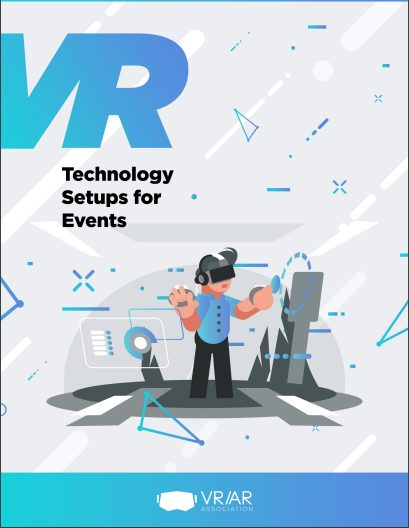
Our Location-Based Entertainment Committee produced this white paper ready to help venue owners setup VR tech for arcades or events for different types of VR experiences.
It includes:
The benefits, tradeoffs, and considerations
Mixed Reality setups
Sanitation options
Shipping checklist
Typical event problems & suggested solutions
VR AR in Healthcare is the Future of Care and the Future is Now. Read about VRARA Members Leading the Way
Join our Healthcare Committee here

Gone are the days of trial and error practice on ‘real’ patients, for medical students and mature Doctors alike. Thankfully for all of us who might be either getting a routine procedure done or nervous about an invasive complex surgery; we can rest a little easier knowing our Medical Professionals have probably practiced and honed their skills in VR. The technology is finally giving healthcare the tools it desperately needs to improve training, provide services in a virtual environment, and educate patients.
Companies like Precision OS Technology, enables users to perform critical aspects of fracture surgery in an immersive, highly realistic setting; which allows for repetition and objective performance measures. Likewise, Trois Prime Lab provides VR Training procedures including knee surgery, hip replacements and sleeve gastrectomy. Similarly, one of the benefits of immersive technology is that the user feels the same amount of mental pressure and physical stressors of a procedure in a modified environment tailored to meet the requirements of specific real-life situations. In effect, VR/AR environmental simulations are giving healthcare professionals the vital experience they need when performing under adverse emergency and natural disaster conditions.
For example, the Thomas Jefferson University DICE initiative is preparing providers to work successfully in high-acuity disaster and emergency situations. In addition, the company INVIVO, enables Surgical Simulation with full interactive large-scale medical devices to smaller hand tools in a typical operating room environment. Both help practitioners know what to expect and prepares them to work efficiently in varied circumstances and environments.
With an aging large generation of baby boomers, in conjunction with average population medical needs, there are not enough Doctors to keep up with the overall demand of care. As a good first step, VR/AR can now enable some medical services to be performed in a virtual environment. For example, the VRHealth Group VRPhysio enables a series of full-body exercises for physical rehab, stimulates patients to perform specific movements and provides real-time data to track progress.
Thomas Jefferson University DICE initiative also provides rehab in VR for cardiac patients. The gamified experiences provide immediate feedback and encouragement to help patients stick with their rehab program, while tracking real-time data and generating progress reports. This can be used for supervised remote in-home care. Some other companies in VR/AR medical services include VR4Neuropain, which combines VR headsets with haptic feedback and bio-medical sensors to integrate virtual and conventional rehabilitation for neuropathic pain; and RelaxVR which provides immersive experiences for stress relief and behavior modification.
One of the biggest issues in healthcare is lack of staff and funding to educate patients on a myriad of programs to improve their outcomes and overall health. VR/AR applications are tackling this problem by educating patients before and after medical treatment. Many Doctors agree that mental preparation before a procedure is just a critical for the patient, as is the surgeon. The company IKONA for example, provides immersive pre-op VR experiences for patients and medical personnel to address factors that may improve patient outcomes. Another patient application geared for aftercare, is an AR enabled pill box that helps heavy prescribed patients order and manage their medication schedule. This can reduce post-op anxiety and give the user a sense of control over their lives. Also helping educate patients in VR/AR is Order 66 Labs; which provides simulations of mutual help groups for patients with addiction seen in hospital. As a result, patients are more likely to participate in these groups after discharge.
Ultimately, healthcare is adapting to the changing needs of the population by creating new tools and methods of care. VR/AR is helping in training, providing services and of course, education. Never before have opportunities in healthcare had such a reach and impact in people’s lives. Even in remote places like the Pacific region, VR in healthcare is making a difference. The company Second Muse Legends, created interactive narratives that teach children and their families about traditional eating and how to make healthy food choices to combat obesity. VR/AR in healthcare is the future of care and the future is now.
Join our Healthcare Committee here

VR & AR in Training Best Practices White Paper
To get your free copy, enter your email address
Thank you to our supporters who made this white paper possible:


This 20+ pages white paper was written by our Training Committee and industry experts.
The VR and AR landscape is fast evolving and provides benefits across many industry verticals. One of the most widely hailed applications of VR and AR is in Training/ Learning & Development because of the seemingly boundless array of possibilities and benefits compared to traditional training methods.
This document outlines and details a set of best practices, aiming to capture the rapidly-evolving field of VR and AR and its use in training and skills development. It is intended for novices to VR and AR technologies which are knowledgeable in current training methodologies and experienced in the general training market. While this document provides an extensive discussion of current best practices and usages, VR and AR continue to grow organically and rapidly. We encourage you to experiment and push the boundaries of what is currently possible with this technology.
The VRARA Training Committee will ensure this document is current through regular updates every six months.
If you want to participate in the Training Committee email info@thevrara.com

Recap of Virtual Reality Arcades Conference in Mountain View, CA
By Deborah Worrell, Member of the VRARA LBE Arcades Committee
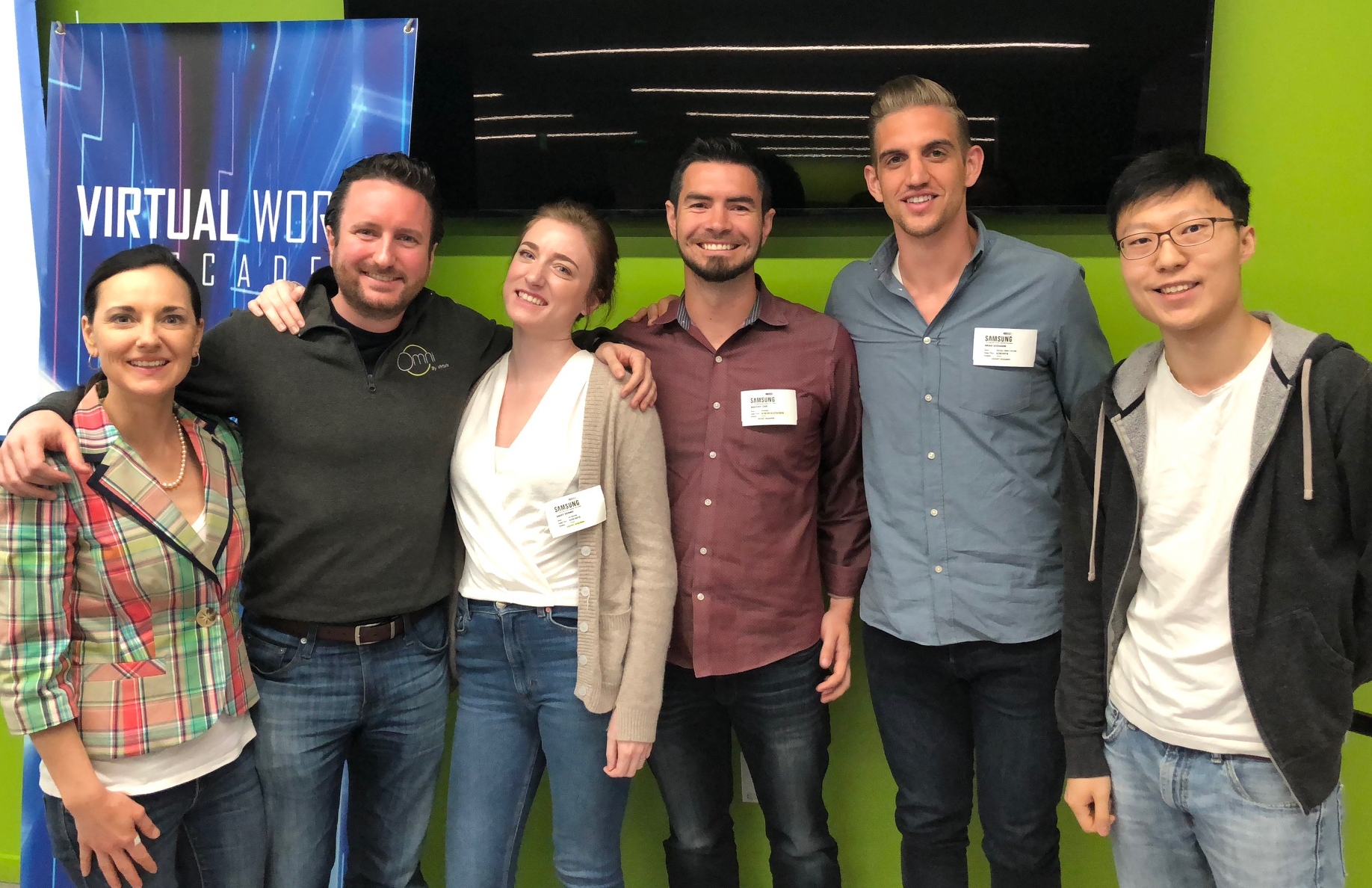

The Virtual Reality Arcade Conference took place last weekend at the Samsung Research Center in Mountain View, CA. The conference brought together companies specializing in VR hardware, software and distribution; VR content studios and publishers; VR research; and experts in funding and financing for VR LBE.
The recurring theme from presenters and exhibitors was one of consultation, cooperation, education and support. Daisy Berns, General Manager of Exit Reality, summed up the spirit of the conference, saying, ‘Virtual Reality is an extremely new industry and it is important for all of us to work together to elevate the entire location-based sector and be mindful that we will be introducing VR experiences to the masses’.
Panels focused on best practices and speakers shared insights based on their own successful models with the audience of arcade owners and interested attendees. Along with seasoned VR location owners a significant number of individuals came to learn about VR LBE and how they can become VR entrepreneurs themselves.
One particularly memorable panel (Jan Goetgeluk, CEO of Virtuix, Brad Scoggin, CEO of SpringboardVR, Shauna Heller, NA President of AiSolve, McKay Christensen, CEO of VR Junkies and Daisy Berns, GM of Exit Reality) had a spirited back and forth about end-user pricing, revenue projections, minimum number of stations and thoughts about keeping high-end VR experiences at an affordable price point. Listeners learned a lot about VR business models, planning for success and the importance of exceptional customer service. The speakers were unanimous in extolling the benefits of marketing services and cautioned the audience against relying on foot traffic.
Attendees and exhibitors had a great time demoing all the new hardware at the conference. Lines were long to try the new omni-directional treadmill from Avatar=VR and the Omni total immersion body rig. Tactical Haptics showed off new gun-like controllers and everyone enjoyed playing Rocket VR’s games. Exit Reality brought a Cube—their complete B2B solution for VR content, distribution and customer service.
Virtual World Arcade showcased a large free roam arena VR set-up and Jeremy Lam, CEO of Virtual World Arcade, delivered Saturday’s keynote on VR Content Development and Mobile Events as well as Sunday’s talk on How to Prevent Motion Sickness in VR Arcades and Games.
The conference drew to a close on Sunday afternoon with an important panel on financing and funding for VR start-ups. In the cooperative and consultative spirit of the program the audience heard experts from the venture capital world (Angelo Del Priore, HP Tech Ventures, Ken Sobajima, KDDI Open Innovation Fund, and Ryan Wang, Outpost Capital) offer best practices, insights and examples.
Overall the event was a huge success—the panels and speakers were insightful and practical, the demos were fun and illustrated where the industry is headed, and the opportunity to network and build partnerships with VR professionals was outstanding. Mark your calendars for Virtual Arcade World Conference next year.
Join our Committee here
What Goes Into a VR Ad Experience?
Join our Advertising Committee here

With nothing more than some basic VR glasses attached to my iPhone, I'm transported to The Conjuring 2 as I watch the three-minute trailer. I feel like I’m in the movie, beginning with the creepy music effects. I'm not sure what is going to happen next, and just that feeling of uncertainty is making my heart beat faster and triggering my senses with giddy anxiety. I know it's not real, but it seems real enough. Everything -- from the furniture to the cracks in the walls -- is just like the movie, and these details of the experience make an impression.
This is advertising in VR. The example involving The Conjuring 2, which allows users to experience Enfield firsthand, was produced by SunnyBoy Entertainment for Warner Brothers, who partnered with Paper Triangles to create the first VR horror movie trailer, to create the first VR horror movie trailer. (Full disclosure: Paper Triangles is a VR/AR Association member.) The trailer has racked up over 13 millionYouTube views and 4.3 million Facebook views.
How To Create a VR Ad Experience
Well, the are several options available now for brands to create a VR, AR or MR experience. The first would be to go to any one of the current production studios. Anzu.io, Blue Visual Effects, CreateAR and many others work in the AR space specifically for brands. Another option would be to create the experience in-house and build a team dedicated to VR, AR and MR work.
Features And Functionality
In this case, creators needed to replicate the set of The Conjuring 2 in VR, which consisted of fusing live-action with CG technology into a stereoscopic VR setting. The result was a remake of the Enfield house in VR form, which made the house look and feel like real life.
Gamification of a branded experience (i.e., an ad) or eye-gaze features to direct the experience can be considered for engagement. The end goal is to surprise and delight the user inside the experience. For examples, using Microsoft's HoloLens allows creators to use spatial mapping, gaze and gestures as tools to immerse users in a branded experience.
How Do You Launch And Measure Success Metrics?
The type of experience you create will determine what platforms are available to distribute your content and how to effectively measure metrics.
In another example, Adverty built a VR/AR advertising platform for brands via an easy-to-integrate, non-intrusive native form of advertising. In 2017, the company launched a Christmas VR campaign for Coca-Cola using virtual out-of-home billboards inside the snowball-throwing VR game Merry Snowballs from game studio Hatrabbit Entertainment. It is a true VR experience, using headsets supported by the mobile and desktop VR platforms, and the ad units are placed non-intrusively and seamlessly in the game design.
Metrics can be measured in the following ways:
• Viewability gives you metrics so you can see the number of views your ad has received.
• Reach is fairly standard, but "resonance" gauges thought and feeling about your ad while "reaction" tracks in-store lift in sales.
• Verification provides third-party data to keep things transparent.
Why does this matter? For now, VR, AR and MR may seem like a novelty. When you mention them to friends or businesses, they, in turn, immediately reference the headset or some type of gear. But what is certain is that the technology behind all three is getting closer to becoming mainstream. More than 1 million headsets were shipped in Q3 2017, and it's expected that over 2oo million units will be sold by 2020. And it's important to remember that headsets are shared devices in homes, schools and entertainment venues. Without a doubt, once a person tries one of the experiences, they are instantly transformed into a smiling, eyes-wide-open user.
For advertising, this is dollar signs and rainbows. Both enterprise and retailers alike will be eager to happily invest in the new medium of communication to get closer to their loyal customers and build new relationships with potential customers. After all, why would you miss an opportunity to tell your story if all you have to do is make the user feel connected to your brand experience?
Join our Advertising Committee here
VR & AR for Business (Enterprise) White Paper
To get this White Paper, enter your email:
This 40+ pages paper was co-written by 9 industry experts and our Enterprise Committee, exploring the positive and lasting impact that VR and AR technologies can have when businesses deploy them to generate substantial revenue, increase productivity or improve safety.
Thank you to Atheer for the support in making this white paper possible.
To get a copy, enter your email below.

Virtual & Augmented Reality are immersive technologies that provide new and powerful ways for people to generate, use and interact with digital information. These technologies take traditional media beyond conventional screens and use photographic images, video or computer generated graphics (sometimes provided as an 360-degree view within your field of vision) as a new communication and interaction medium that can be used across your company from marketing and sales to field services, training and data visualization.
Companies like Walmart, Farmers Insurance and Boeing have already begun deploying this technology across their organizations for training. Specific examples of how other brands are using VR/AR right now are detailed in this paper. Whether you are a brand marketer, director of operations, run a line of business or head of HR, there are many ways you can deploy this technology to generate substantial revenue, increase productivity or improve safety.
This white paper is broken into the following parts so you can skip to what is of interest to you:
Market Predictions for VR/AR
Key VR Industry Market Size Estimates
Market Size Estimates: Drilling Down on Enterprise
How to use Virtual Reality in your business?
20 uses of VR/AR for Business
Deeper Dive on Examples
Preparing Your Business for the Immersive Future
8 steps to build your VR/AR experience
Use Cases
Retail
Real Estate
Airlines
Automotive
Banking & Financial
Health & Medical
Virtual Reality Architectural Renderings
Industrial (Mining, Oil & Gas, Manufacturing)
VR Simulations & Data Analysis
Restaurant & Food
Travel & Tourism
Communications & HR
Different Types of VR
Uses for VR/360° Video
Computer Generated (CG) Virtual Reality
WebVR
VR Head Mounted Displays
AR Head Mounted Displays
Challenges Facing VR/AR Adoption
Conclusion
Using VR to Attract Tenants and Investors for Real Estate Projects
By Kelly Burke, VIATechnik and Participant in VRARA AEC Committee

The VR/AR Association AEC Committee is dedicated to crafting a set of guidelines, best practices, and calls to action for the use of VR, AR, and MR tools in the architecture, engineering, and construction industry. This is the first installment in what we hope will become an ongoing discussion on the wide-ranging benefits of these emerging technologies in the broader AEC space. Join our Committee here.
While the first head-mounted display (HMD) debuted back in 1968, virtual reality (VR) has only started to come into its own in the last several years. In fact, IDC estimates that global revenues for the augmented and virtual reality (AR/VR) market grew by a remarkable 130.5% over the last two years, leaping from $6.1 billion in 2016 to $13.9 billion in 2017. What’s more, the AR/VR market is expected to achieve a compound annual growth rate of nearly 200% between now and 2020.
As the technology continues to mature — and as HMDs become increasingly affordable — VR will revolutionize the way in which AEC stakeholders approach their work. Indeed, from improving the safety of worksite operations for contractors to facilitating cooperation between architects and structural engineers during the design process, immersive — and even interactive — virtual environments have already begun to change our industry for the better.
But if there’s one group of AEC stakeholders that’s particularly well-positioned to take advantage of everything VR has to offer, it’s real estate owners/investors and the tenants to whom they market.
With VR, There Are Many Places Like Home
Selling possible tenants on a property’s potential has always been one of the most frustrating parts of real estate. People looking to rent or buy an asset spend hours driving — or even flying, if they’re from out of town — to different buildings to get a feel not only for the unit in which they’re interested, but for the building and neighborhood in which it’s located.
Sellers’ agents have become adept at crafting flashy slideshows and even video walkthroughs to give potential tenants an idea of what a property has to offer, but these kinds of collateral will never replicate the experience of wandering through a physical space in person. VR not only offers a way to bridge this divide, but provides an incredible boost to efficiency, as well — for real estate professionals and potential tenants.
“Previously, potential buyers had to travel to visit a property. Now, this step can be skipped thanks to VR,” explains Rentberry’s Oksana Tunikova. “There’s no limit on the number of people who can view the same property at one time, and potential buyers can see dozens of properties in a fraction of the time.”
VR doesn’t merely improve the efficiency of the property touring endeavor, however. It also improves the depth and, ultimately, the effectiveness of a tour. According to the National Association of Realtors, “77% of buyers’ agents say staging a home makes it easier for a buyer to visualize the property as [their] future home.” Further, 50% of sellers’ agents report that staging a home increases the dollar value of buyers’ offers by as much as 6% to 10% — and 62% of sellers’ agents agree that staging a home decreases the time a property sits on the market.
In short, convincing a potential tenant to make an offer on a property begins with helping them picture themselves living (or working) there, and there’s no better way to do so than by letting them “experience” the property virtually. As VR expert Boaz Ashkenazy puts it, “Virtual reality’s photorealism can zoom in on selling-point details of surfaces and lighting, as well as immerse you in views from a veranda that feel utterly real. Potential buyers or renters now have an emotional connection to what they’re experiencing.”
Companies like roOomy already enable sellers’ agents to virtually stage a property with “digital decorations” that align with each potential buyer’s tastes, and it’s only a matter of time before this kind of digital staging makes its way into the VR space. Once this occurs, potential tenants will be able to insert fixtures and furniture closely resembling their own into any property, completely redefining the meaning of a “personalized tour.”
Exploring a Building Before It’s Built
From an investor’s perspective, VR has the power to dramatically improve project pitching. Simply put, the human mind struggles to visualize size and scale in the abstract, making it all but impossible for us to accurately transpose two-dimensional design drawings — or even to-scale 3D renderings — into a mental image of a lived space. This innate shortcoming is a real obstacle for anyone attempting to evaluate a building that exists only on a page or a screen.
With VR, these issues are no longer a problem. “This [technology] will allow architects and clients alike to truly understand the spatial qualities of a project,” says The Future Group’s Kim Baumann Larsen. “This spatial understanding should make clients more confident in the design and reduce time spent in meetings and the use of lateral design revisions.”
Of course, all of these benefits — for real estate agents, tenants, architects, and investors — are only realized when everyone has access to well-designed, truly immersive VR simulations. Different VR environments are rendered at different levels of detail — from rough, non-photorealistic polygons to hyperrealistic responsive objects — and at this still early stage of technological development, it takes a true VR design expert to tailor each environment to its situational demands.
From physically-based rendering tools used to mimic the way light reflects off different shapes and textures to sculpting tools like ZBrush used to craft intricate objects like sculptures or ornate lamp posts, VR designers must be familiar with a wide range to tools in order to produce top-notch AEC virtual experiences. When they get it right, however, the results speak for themselves:
The Power and Potential of VR for Impact
By Davar Ardalan
Founder and Storyteller in Chief at IVOW & co-chair of the VRARA Storytelling Committee.

My Beautiful Home is one of the five 360/VR films selected in the 5th annual Socially Relevant Film Festival in New York.
As I considered how to select the 360/VR films for the 5th annual Socially Relevant Film Festival in New York, there were several criteria to include. How immersive and engaging were the films; what kind of impact did they have on us; did they have a creative approach to filming, sound, and storytelling; and finally, how original was the interaction? These questions were inspired by SwedenVR, an international VR competition that takes into consideration UN Sustainable Goals when judging films and their impact.
My Beautiful Home and The Great, two of the 360/VR films showcased at this year’s festival, exemplify the transformative qualities of VR. Both films move you to your core but in completely different ways.
The Great invites you on an exhilarating dive with great white sharks. While the filmmaker is in a cage behind you or to your left or right, you’re immersed with a shark in crystal blue waters in the western frontiers of Mexico. The shark is free and you are mesmerized by the sheer strength and beauty of its nature and physique. The instant when you sense a shark coming towards you is surreal and powerful.
My Beautiful Home, set in the slums of Kibera, Kenya, although not nearly as well-produced as The Great, had much more of a personal impact on me. Lucy Ochieng of Kibera is our guide throughout this powerful story that chooses to dwell on the richness and universality of creativity and community rather than the extreme poverty that surrounds us. The spirit of the film is genuine and together with the narration, the whispers were effective in making me care and pay attention. Compared to the other films nominated, there was an unmatched depth and immersive sensibility to this film.
Discovering the raw power of VR as an impactful storytelling tool has been one of the most fulfilling experiences of my career as a journalist. I spent two decades at NPR News producing national and international broadcasts including NPR's Weekend Edition, Tell Me More, and Morning Edition, where I helped shape the newsmagazines and was responsible for decisions that required elaborate coordination such as broadcasts from Baghdad, Kabul, New Orleans, and Ferguson, Missouri.
I left NPR in 2015 and joined the open innovation space. Working with SecondMuse, I designed a global immersive storytelling call-out around healthy eating in the South Pacific, funded by the Australian Government Department of Foreign Affairs and Trade’s innovationXchange (DFAT iXc). The selected pilot programs, produced by storytelling agencies in Sydney and Melbourne, will launch in late April and are geared towards tackling malnutrition and bringing pride back to traditional diets via VR and gamification.
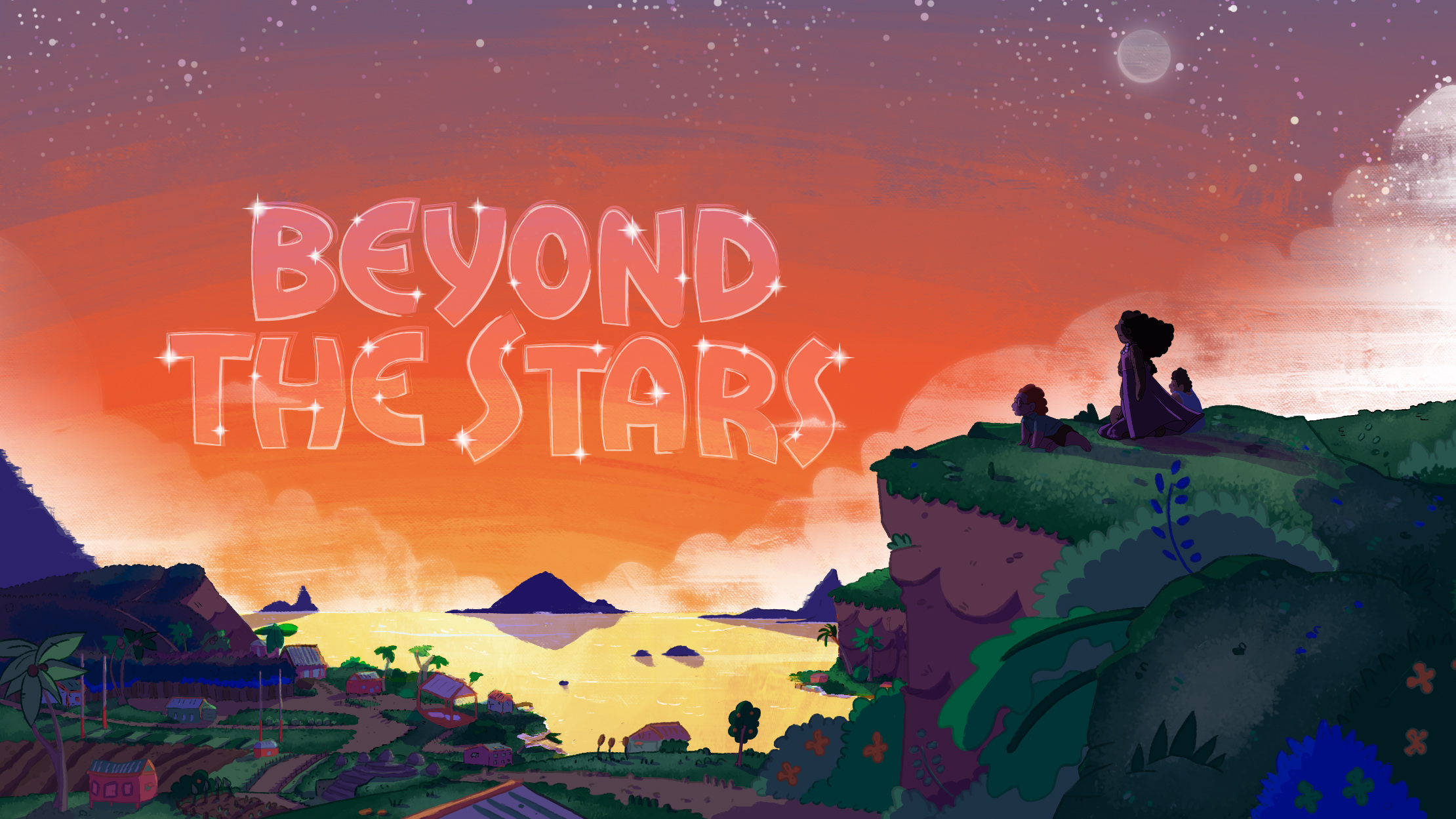
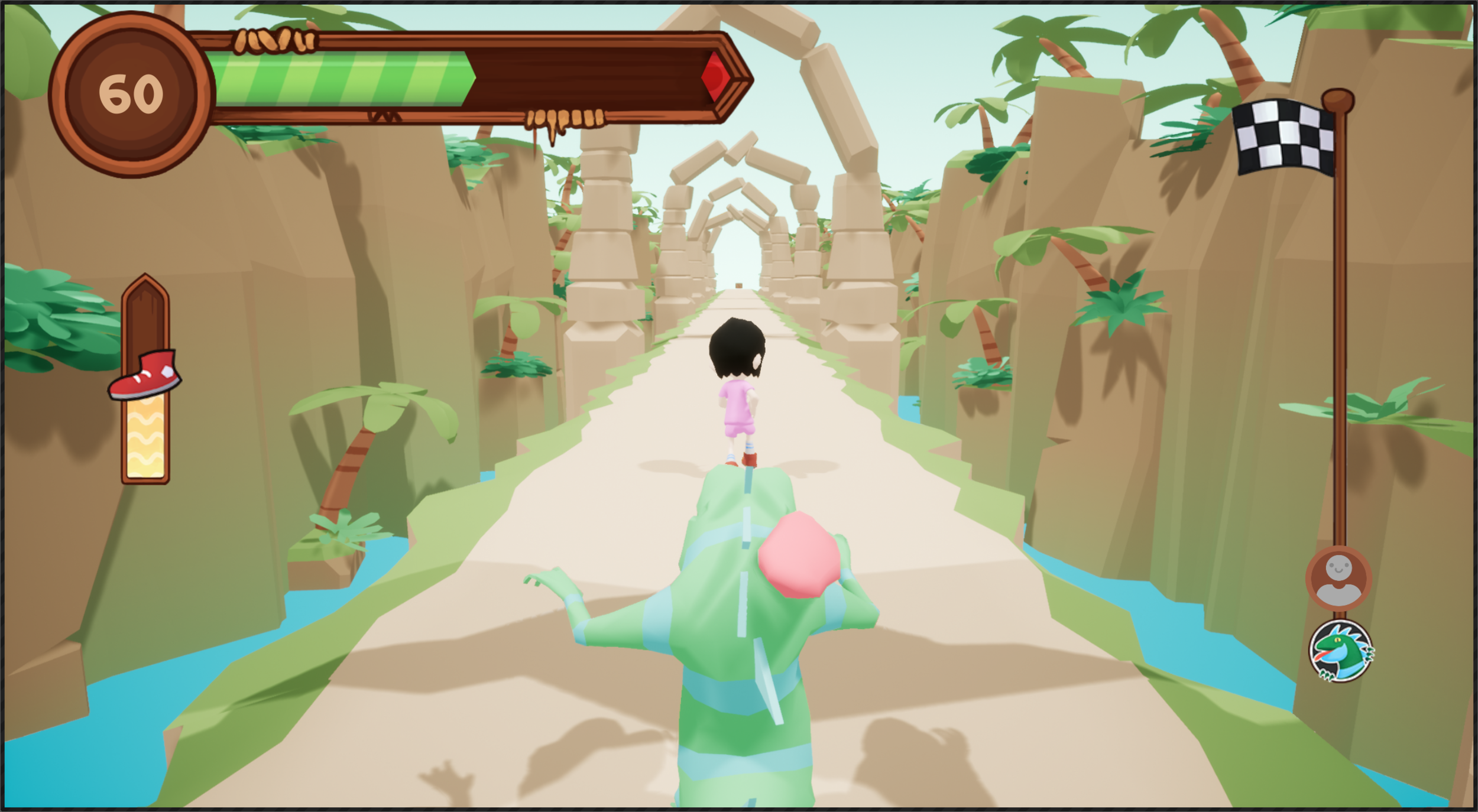
Tash Tan is the co-founder of S1T2 in Sydney and the creator of Beyond the Stars, an educational program that uses innovative technology, play-based learning tools, and storytelling mediums to inspire children in Fiji to adopt healthy living habits, self-educate on subjects from their school curriculum, and consider the impact their actions have on the environment. Set across the backdrop of the Pacific Islands, the heroes of Beyond the Stars journey with students across islands, through mountains, and into underwater caves searching for legendary sacred relics that have been imbued with the wisdom of an ancient civilization. This knowledge is the key to restoring health and prosperity in the Pacific and preserving the natural beauty of the land.
S1T2 uses virtual reality to introduce this story in a first-person format that allows children to embody their character’s journey in the virtual world. Starting from the comfort of a familiar classroom, the story quickly moves to magical environments, merging fiction with reality. In the VR experience of Beyond the Stars, the hero is the protagonist urging children to make choices in the story world -- a consistent theme used to underline the importance of decision-making when it comes to healthy living and nutrition.
Tan says that action starts with empowerment, and in Beyond the Stars this is a central motif. “We use technology to enrich our story by allowing as many aspects of the story world to be interactive,” Tan says. “This not only gives children the chance to try, and try again in a safe environment, but also creates an understanding that everyone has the power to make a difference. This application of gamification methodology is essential to teaching healthy living because we are faced with decisions and choices every day on what to eat, how to live our lives, and our adoption of local tradition and culture.”
The purpose of the virtual reality experience is to imbue a sense of wonder within each child so that when they are exposed to other low-tech mediums they manifest their imagination into the program.
“We utilize transmedia storytelling in a similar manner that Star Wars and Harry Potter share their characters, stories, and universes over multiple mediums,” says Tan. “From initial reports and evaluations, we’ve found that this approach is proving to be immensely rewarding even in an educational context, as children are not only able to articulate the narrative of Beyond the Stars, they are also able to demonstrate an understanding of the program learnings and impact outcomes behind the narrative.”
One of the key VR storytelling elements that S1T2 has introduced into the VR narrative is Masi -- a flying cloth made from treebark. Masi is the companion who guides our heroes on their VR journey. “He is a bit cheeky and likes to play games with our hero,” Tan says. “In one scene for example, Masi imitates the player’s movements accentuating your agency over the world. This in some way makes the fictional world feel more real -- you are a protagonist who has a reciprocal relationship with the characters in VR.”
Allan Soutaris of SecondMuse is the director of the Legends project. He says the key to making it successful is to involve stakeholders from across the island nation of Fiji -- including the Ministries of Education and Health, as well as teachers, students, and parents.
“From the outset, we've worked closely with educators, cultural advisors, and local artists to ensure the program is very much a product of Fiji for Fiji,” Soutaris points out. We consider those stakeholders as co-creators and owners of the program, and their input has informed key elements of the narrative, structure, and classroom delivery. Without the valuable insight provided by schools and communities, I don't believe the program would resonate nearly as much has it has so far. There is a real sense of magic to the narrative that could have only come from an approach such as this.”
The inspiration I found in my work with SecondMuse and the Legends Projects led me to start IVOW, a storytelling agency powered by AI & Culture. Part of our mission will be to strengthen metadata in 360/VR storytelling. It is said that the best stories are not just read or heard -- they are felt. VR provides us a unique way to live inside a story, to experience an imagined world and the real life of the characters and creatures that shape our existence.



Davar Ardalan is the founder of IVOW, a storytelling agency powered by AI and culture. She’s also senior advisor to the Legends project in the South Pacific along with Ben Kreimer, IVOW’s Director of Storytelling Technology. Ardalan was formerly the director of Storytelling and Engagement at SecondMuse and an award-winning journalist for National Public Radio from 1993–2015.
The Transformation Of Retail Shopping With Augmented Reality

Join our Retail Industry Committee here
Technology is helping retail make shopping fun again. Shoppers no longer have to visit brick-and-mortar stores and peruse for neon "open" signs. Now your smartphone can function as a personal computer and you can have access to a digital shopping cart and register with just a few simple clicks. For the most part, retailers have done an adequate job of adapting an omniexperience model for their customers, but something was still missing. However, this changed when augmented reality (AR) arrived on the scene.
Apple (ARKit) and Google (ARCore) are facilitating this change by embedding AR technology into their respective smartphones to allow developers -- and by extension, retailers and marketers -- to create incredible AR experiences. In fact, Digital Bridge shows that 74% of consumers now expect retailers to offer some type of AR experience. AR is set to reconnect physical and digital retail.
This includes building deeper messages via AR in all in-store signage, having AR hosts that direct consumers to specific departments within a store, co-branded augmented products with shelf-talker callouts and instant coupon delivery based on AR actuation.
As far as applications go, Overstock.com updated its iOS app to allow users to view its products via augmented reality thanks to Apple's ARKit. (Full Disclosure: Overstock.com and AkzoNobel are VR/AR Association members.) This feature allows users to actually see what certain pieces of furniture might look like in their own homes or offices, much like the IKEA application. Thanks to AR, which uses visual search or image recognition, it's making it much easier for consumers to find exactly what they are looking for instead of doing traditional Google Searches. The technology also encourages customers to test the app out and pull the trigger on purchases. According to Amit Goyal, SVP of product and engineering at Overstock.com, the company has seen an increase in adoption and conversion. "The major win is the increased customer engagement in the app."
As every new technology, AR is primarily being used by the innovators and those who are ahead of the curve. But even struggling retailer Toys R Us, a company I used to work for, has tapped into the potential of AR to bring back fun and excitement into it stores and woo shoppers. Based on 2016 data, the vast majority of Toys R Us' revenue is still generated it its stores, so in-store experiences that drive foot traffic and are in line with customer expectations are essential. Although it's doubtful that Toys R Us' AR experiences will ever reach the popularity of something like Pokemon Go, the company made a smart move in creating several next-gen AR experiences for your smartphone and tablet that can be only activated in the store, making the landmark retailer a fun destination.
AkzoNobel, a Dutch company that creates paints, launched an AR app called the Visualizer, which has been downloaded 18 million times globally. The app is a great example of how AR technology can solve a specific use case. Choosing the right paint color for a room in your house can be stressful because it's hard to envision what the room will look like once it's completely painted. In order to help give you confidence in your color selection, the app allows users to see what a room could look like in a variety of different colors in real time -- all before any paint is applied to the wall.
AR solutions are not out-of-reach solutions in the retail space -- they are real, and consumers love them. In fact, 69% of customers expect to have access to AR apps from the stores they love to shop at over the next six months. The more users feel connected with the product in AR, the easier it is for them to purchase items and share fun content with friends and family online.
Join our Retail Industry Committee here
Recap of our VR AR Online Conference: 75 Speakers, 9 Tracks, 10000 Viewers
Watch the recording of the online conference here
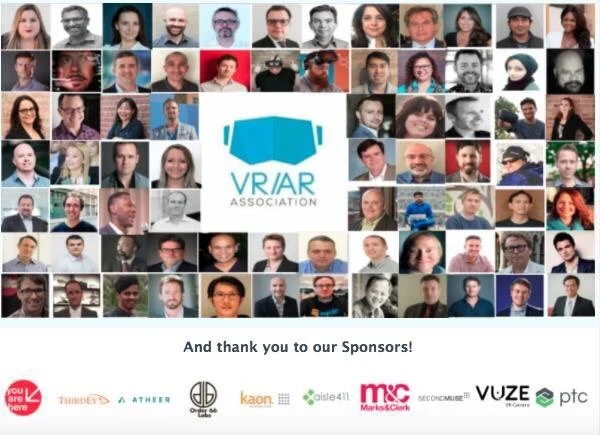
Thank you to everyone for making our VR AR Online Conference a success! We had 75 Speakers and over 10000 views. Our Industry Committees presented 9 tracks including: AEC, Education, Enterprise, LBE Arcades, Marketing & Advertising, Retail, Storytelling, Training, and WebVR.
Special thanks to our Sponsors:
You Are Here - an immersive experience lab that helps agencies and brands engage customers with a strategic mix of innovation technologies for events, marketing, and training all over the world.
Atheer - AiR Enterprise is the award winning AR software platform for industrial enterprises.
ThirdEye Gen - Our X1 Smart Glasses™ represents the latest in powerful AR smart glasses technology .
PTC - a global software company that delivers a technology platform and solutions to help companies design, manufacture, operate, and service things for a smart, connected world.
Kaon Interactive - a provider of interactive 3D marketing applications that help B2B marketers and salespeople demonstrate and differentiate products anywhere, anytime, on any device.
Vuze - the world's leading VR Camera developed by Humaneyes
Marks & Clerk - Patent Attorneys, Trade Mark Attorneys, Lawyers, Consultants.
aisle411 - We create the WOW factor for your customers by adding Augmented Reality to your venue.
Order 66 Labs
SecondMuse - We are an innovation agency designed to tackle complex problems.
Watch the recording of the online conference here

Enterprise AR is Going to ‘Get Real,’ and More Predictions for 2018

Join our Enterprise Committee
Google, Amazon, Facebook, Apple, Samsung and Microsoft all want a piece of the VR/AR pie – not to mention Magic Leap, whose first consumer product is “coming soon.” VR/AR is about extension, engagement and monetization. Not since the 1980s have all the big tech players been battling for consumer attention and dollars. So, what is on deck in 2018, and why should we care?
These are the trends highlighted by ARtillry Intelligence for 2018:
Enterprise pulls ahead
Enterprise AR is going to get real in 2018, with companies capitalizing on ROI in both efficiencies and error reduction. Think processes, and how interdisciplinary teams can work better together.
Mobile AR rebounds
Mobile AR is set for big wins in 2018! With everybody owning better and higher-resolution phones, the adoption of mobile AR is a natural evolution. AR app revenue is due to increase because companies will start creating AR apps to sell their products and further extend and engage their customers.
Mobile AR standards develop
With both Google and Apple introducing AR offerings into their lineups, coupled with increased demand from retailers, native AR and AR-first mobile app experiences will rule 2018. As a result, AR standards are set to be solidified this year. User experience will be top-of-mind for product managers.
Consumer VR gets a jolt
With Oculus Go set to release in mid-2018 and reportedly to be sold at $199, consumers will happily buy in to provide a jump in the VR market.
Unifying technologies emerge
As platforms and fragmentation continue to evolve, consumers and enterprises alike will look to tech that provides seamless execution. Enter WebVR/AR. In addition, expect to see more tools for developers and options for enterprises.
Ultimately, it will be a race to 100 million VR/AR units sold. According to ARtillry Intelligence, “That’s the size of the installed base that will be a key milestone and turning point for VR. It’s the number that attracts content creators and supporting functions, as well as a network effect.”
What is the unit price that drives the market? $200-$400. How many years until VR/AR reaches the magic 100-million mark? Three years.
We already know that games with in-app purchase business models are proven revenue generators. So, companies in 2018 will try to tap into ROI success experiences and experiment with location-based promotions and sponsorships. Overall, with investment dollars continuing to flow, the market is not slowing down.
The year 2018 will bring more strategic investment, business development and spend in VR/AR. Some unicorns should expect to see their rainbows narrowed – but more established businesses will begin to taste the ROI of user-based VR/AR experiences.
Published by ISACA News

Virtual Reality: The Next Generation Of Education, Learning and Training

When people hear about virtual reality (VR), images of a person wearing a headset and holding a gaming console usually come to mind. However, for the education sector, VR is an opportunity to finally connect with both learners and teachers in a novel and meaningful way. For example, EON Reality collaborated with Oral Roberts University to create the Global Learning Center, a dedicated facility for augmented and virtual learning.
As the global executive director of the global VR/AR Association, I've watched our 3,900-plus registered companies and our Education Committee and Training Committee work on best practices, guidelines and standards to accelerate the VR/AR industry for all, one committee in particular being devoted to education and training.
Today, VR can enable experiential learning by simulating real-world environments. Students can test their skills, record their work and interact with experts all within VR. Students have responded overwhelmingly positively to active learner engagement. A recent study shows that "93 percent of teachers say their students would be excited to use virtual reality and 83 percent say that virtual reality might help improve learning outcomes." This points to a universal trend as these students will soon enter universities and then the workforce, where job training scenarios will become the new classroom.

For visual learners and individuals with learning challenges, VR provides an alternative medium to meet their needs. Likewise, educators see increased engagement levels and improved test scores across the board with VR education programs. Hands-on learning techniques like VR education directly contribute to increased cognitive memory.
The benefits of incorporating VR/AR tech into educational experiences include better, more immediate engagement and the opportunity for learners to "feel" the experiences and better remember and express what they learned. A student can experience what was not possible to experience before and become better prepared for when such experiences occur in the real world.
The basic functionality of VR in education is to bring learning to life via a virtual environment. The more a learner is able to participate in life-like engagement, the easier it is to personally feel a connection to the subject material, making it easier for application and retention of the subject matter.
The most popular trends in VR learning include enterprise and education. In enterprise, Walmart is using VR to help train its employees on topics like management and customer service. Soon, all 200 of the company's U.S. training centers will use VR instruction to educate the estimated 150,000 employees going through the program annually.
In education, there's Star Chart, an iOS and Android app with over 20 million users that brings the universe a little closer. Users learn about astronomy by pointing their phones to the sky at night and utilize other features to learn about planets and space discovery.
It’s important to pay attention to this trend and adopt VR solutions in your organization to educate employees in new and better ways and teach students with more engaging and effective tools. However, like many new technologies before it, awareness is the first barrier to entry followed by cost and content.
Many are still not aware of VR training solutions that are proving to be effective. At The VR/AR Association we are doing our part to promote the industry and help organizations locate the best VR solutions for their use case. Meanwhile, quality VR headsets come at around $399 (already down from $599 ore more just a few months ago). Cost is steadily declining our research points to $199 being the sweet spot price point for “mass adoption.” Finally, better content — specific for each use case — is needed and is being created for enterprise use cases and educational curriculums.
In 2018 we will see the costs decrease, better content emerge and more awareness spread, which will propel the VR/AR education market to high growth.
Ultimately, VR in education will revolutionize not only how people learn but how they interact with real-world applications of what they have been taught. Imagine medical students performing an operation or geography students really seeing where and what Kathmandu is. The world just opens up to a rich abundance of possibilities.
Exploring Virtual Reality as a Forensic Tool Criminal Justice
By Eduardo Neeter, Principal, FactualVR, Inc.

Virtual reality (VR) offers unparalleled capabilities to support and facilitate forensic activities. VR and other related technologies, like augmented reality (AR) and mixed reality (MR) have been around for more than half a century, but it is only in the last few years that it has shown the potential to go mainstream.
The question if VR will successfully go through massive adoption, and if users will ever want to walk around with digital glasses that sense and display information everywhere is still not answered, and it will likely take a few years to know for sure.
What is clear at this point in time is—given the increased power and reduced cost of the VR building blocks that are required to provide a truly believable experience—this technology will be widely adopted across specific target domains. Tools supporting use-cases where spatial information is critical, like crime scene reconstruction, will be able to leapfrog current capabilities. For these specific areas, VR could prove to be the most powerful media ever invented.
Presence through immersion
The main capability offered by virtual reality is that it “tricks” the users into a sense of “presence.” The sense of presence is well defined1 as “the subjective experience of being in one place or environment even when physically situated in another.”
A VR environment can deliver the sense of presence by leveraging immersion capabilities. Immersion describes the extent to which technology is capable of delivering a vivid illusion of reality to the senses of a human participant. A well created VR environment will reproduce images and sounds of a scene from the point of view of the user, and deliver in real-time these images and sounds adjusted to each user’s eyes and ears, based on the user’s position and orientation. It will also render the digital images from the user’s perspective with enough precision and sufficient frequency that it causes the user’s brain to reconstruct a 3-D model of the scene, and place the user at the center of such model. Long story short, the VR environment makes the user “feel” that he or she is at the scene.
In addition, this idea can be extended to emphasize the fact that the VR experience is facilitated by means of a communication medium, and as such, it can take place remotely, therefore the term “presence” in the VR context is also referred to as “telepresence.”
VR/AR Association (VRARA) Criminal Justice Committee - Hands-on Encounter
With the interest to explore and study the impact of VR in policy and practices across the Criminal Justice domain, the VRARA Criminal Justice Committee was founded by co-chairs Rory Wells, Assistant Prosecutor in Ocean County, NJ, and Eduardo Neeter, Founder of FactualVR, a technology start-up providing VR services for crime scene reconstruction. The scope of the new committee includes a broad range of use-cases, such as investigations, future courtroom applications and rehabilitation.
The VRARA Criminal Justice Committee held its first hands-on meeting September 22, 2017. Multiple law enforcement agencies, academics, non-profits and providers from the United States and Canada met for a first of its kind seminar and discussion on the impact of VR and AR on the criminal justice system. The meeting covered demonstrations of the latest technology, including VR applications from event co-sponsors FARO Technologies and FactualVR. The topics ranged from training and investigations, to the use of VR at trial, and the use of VR for rehabilitation/reentry after serving time in prison.
Participants included forensic professionals and officers from multiple crime scene units, including NYPD, Toronto PD, Westchester County, NY and Hudson County, NJ.
Discussions centered around or focused on the benefits and potential of VR technologies, compared with current tools and practices. One of the attendees said, “The person in charge of the case sometimes doesn’t go to the crime scene for days or weeks, and in some cases doesn’t go at all. With this technology, they could walk into the scene right away, whenever they want.”
Collaboration and communication between investigators and prosecutors appears to be an area of interest and could offer significant value. This area could demonstrate the potential of VR as a productivity tool, as it has the potential to allow people do things they couldn’t do before, and at the same time, be able to do it more efficiently and with less friction than ever.
Detective Donald Palmer from Westchester County (NY) attended the VRARA event in September. We met again at the IAFSM conference in Atlanta about six weeks later. At the IAFSM conference, Palmer mentioned they had already started to test the VR capabilities in-house.
“Based on the VRARA presentation we bought a VR headset," he said. "We have been testing the VR software and showing our bosses how the scans look in VR. Everyone is beyond impressed with it. We are going to work with the Forensic Coordinator ADA from our DA’s office to determine if or how this could be shown in court.”
Looking forward, we are witnessing the emerging of a medium that could change the way we communicate, especially how we communicate about places and scenes, and anything related to spatial and 3-D information. It’s not a matter of if but "when," as the technology continues to mature and becomes mainstream, people will eventually demand that VR be used in every courtroom.
References:
1. Witmer, B. G., & Singer, M. J. (1998). Measuring presence in virtual environments: A presence questionnaire. Presence: Teleoperators and virtual environments, 7(3), 225-240.

Watch the Recording of our Symposium: VR & AR in Healthcare
The VR/AR Association Healthcare Committee has produced this online event that was attended live by 500 doctors, specialists, and executives from around the world.


ETSI, VRARA to work together on Virtual and Augmented Reality for 5G

Join our 5G Networks Industry Committee here
European ICT standards body ETSI and the global VR/AR Association (VRARA) have signed a letter of intent to collaborate on interactive VR and AR technologies delivered over emerging 5G networks and hosted on Multi-access Edge Computing (MEC) sites. The partnership is designed to encourage common member companies to pursue VR/AR-focused use cases and requirements for ETSI MEC Phase 2 with a view to ensuring that the resulting specifications address the needs of the sector.
VRARA will also support adoption of ETSI MEC work as appropriate and highlight benefits of Edge computing to VR/AR solution developers, said the partners in a statement.
“Virtual and Augmented Reality technology holds the promise to fundamentally transform how people interact with and experience the physical world, how they are entertained, and how services are delivered to them.” states Alex Reznik, ETSI MEC chairman. “We are at the cusp of this transformation, and, yet, it cannot happen unless the networks that will have to support these applications can deliver the required performance, e.g. latency on the order of several milliseconds. Edge computing is necessary to deliver such performance; while mobile networks, which today already provide pervasive global connectivity, are likely to continue occupying this central role.”
The partnership between ETSI, the home of the world’s leading Multi-access Edge Computing standardization activity and VRARA, the world leading industry association representing the Virtual and Augmented reality industry recognizes the need to bring the two communities together. This cooperation will encourage common member companies to pursue VR/AR focused use cases and requirements for ETSI MEC Phase 2 so as to ensure that the resulting specifications address the needs of this key industry sector. VRARA will support adoption of ETSI MEC work as appropriate and highlight benefits of Edge computing to VR/AR solution developers.
“In a recent research report we’ve published, we learnt that enterprise AR & VR have more receptive buyers than consumer markets, due to a strong ROI case.” says Kris Kolo, Executive Director of the VR/AR Association. “Working closely with ETSI which expertise lays in all ITC related sectors makes sense. We’re really excited to start this collaboration with their MEC group.”
About VRARA
The VR/AR Association (VRARA) is an international organization designed to foster collaboration between innovative companies and people in the virtual reality and augmented reality ecosystem that accelerates growth, fosters research and education, helps develop industry standards, connects member organizations and promotes the services of member companies.
For more information please visit: www.thevrara.com
About ETSI
ETSI produces globally-applicable standards for Information and Communications Technologies (ICT), including fixed, mobile, radio, aeronautical, broadcast and internet technologies and is officially recognized by the European Union as a European Standards Organization. ETSI is an independent, not-for-profit association whose more than 800 member companies and organizations, drawn from 68 countries across five continents worldwide, determine its work programme and participate directly in its work.
For more information please visit: www.etsi.org
Contact
Kris Kolo
Tel: +1 650 690 5361
Email: kris@thevrara.com
Claire Boyer
Tel: +33 (0)4 92 94 43 35
Mob: +33 (0)6 87 60 84 40
Email: claire.boyer@etsi.org
Virtual Reality, the Next Generation of E-Learning in Schools
Co-Authors: Kris Kolo, Harry Evry, Carlos J. Ochoa, Rachel Ralph, Derek Jacoby, Yvonne Coady, Craig Vezina, Alisher Farhadi, Ross Cohen
This article was written by VR/AR Association's Education Committee and features examples from Association members.
Thank you to our sponsor CingleVue.

VR and AR technology is rapidly evolving and is beginning to impact many fields and industries. VR has the potential to immerse audiences, capture attention and dramatically reveal and showcase crafts, skills, sciences and systems in very memorable ways. It can transport students into real-world or simulated locations or simulated environments, and interactively test and record their skills and reactions in a wide range of situations.
VR and AR can be used to invite world-renowned experts into the classroom, and introduce exhibits and examples that might be otherwise too costly, rare, destructive or hazardous to actually bring into the academic environment. Both technologies can be leveraged to overcome issues of risk, time and scale, allowing students to experience situations, processes and phenomena that might be difficult to perceive or observe in physical reality.
Today, educators can provide experiential learning without ever having to leave the classroom. Companies like VReducation have built VR experiences that take the concept of ‘learn through experience’ seriously. The company, based in Waterford, Ireland, created an education platform called ENGAGE that gives students and teachers the ability to communicate in a safe, virtual environment. The system allows up to 30 users into an experience at a time and has virtual assets such as presenter tools, interactive whiteboards, and streaming media features to keep things focused. The company’s Apollo 11 VR experience has already won multiple awards, and the upcoming Titanic VR is set to debut later this year.
Example: Schell Games SuperChem VR
Schell Games is one of the largest independent game studios in the US, and it aims to bridge education and entertainment. With support from an IES SBIR grant, one of their experiences is called SuperChem VR, a VR chemistry lab that feels every bit as tactile as its real world sibling. Students can perform specific measurements, conduct real lab procedures, and get real-time assistance. SuperChem VR prototype currently runs on the HTC Vive to allow for maximum hand and body movements in the learning space. The high-quality hardware allows players to focus on realism and accuracy without sacrificing visual and gameplay quality.
Example: WebGuys VR E-Learning Platform

WebGuyz provides educational experiences through VR AR. Currently, Webguyz is partnered with NYC Dept of Education, UFT, NYIT, and Jump into the Light as well as Cisco Netacad to make VR and MR accessible to public as well as private school students. WebGuyz has created VR/AR experiences and curricula that are fully aligned to the common core and NY State Regents Examinations. Students are learning animation development and web development for VR, along with VR cyber security training. With more and more opportunities being developed for e-learning, WebGuyz is excited to clearly see VR/AR at the forefront of experiential education.
Example: ONE Digital SmartEducationLabs

SmartEducationLabs (SEL) is a platform for educational services from ONE Digital, which includes VR & AR. SEL is compatible with traditional, multimedia and smart classroom lessons, and is used as a complement and not as a substitute for current systems. Some Schools in Emirates and Spain are already working with SEL.
In 2016, The Ministry of Education of Emirates, implemented a Learning Resources Centers (LRC) Program in schools. Every LRC is equipped with VR/AR devices. The software suite includes virtual learning worlds complement text and pictures with a 3D experience.
Example: Steven Bambury at the JESS Dubai School
Head of Digital Learning and Innovation at JESS Dubai, Steve Bambury, uses VR headsets for use across the curriculum and staff regularly harness applications like Nearpod, Google Expeditions and YouTube 360 to share content with students. JESS continues to pioneer and seek new opportunities, running pilot schemes for LifeLiqe in Science, Kubity in DT and ImmerseMe in the Modern Foreign Languages Department. Another key pilot scheme has been Timelooper, an amazing VR platform for learning about history that transports students back in time using a clever mix of re-enactments and digital effects. Timelooper is primarily being harnessed in Key Stage 4 with GCSE students but younger students have also been able to engage with some truly unique experiences such as the Year 6 students who travelled in time to experience The Blitz in WW2.
Example: RealCast VR History & Culture
Founded by pioneers from education, robotics and game production, RealCast is using VR AR to fundamentally transform our relationship with history and culture. Based out of Paris’ Station F (stationf.co), the company develops new forms of multi-user interaction in VR AR to create seamless interactions between historical characters, settings and artifacts so as to powerfully enhance users' understanding of bygone times. Its first In Situ Experience (ISXP) use-case provides interactive AR experiences via HoloLens for medieval castles with leading international educators and scholars as content and storytelling advisors. In addition to high-level content, RealCast is also developing a platform which will serve as sort of "time machine" for developers to build their own VR AR content with the aim of bringing history alive in powerful and unprecedented ways.
Example: Transmersive VR AR Exhibits
Transmersive Media and Exposition Online, Inc is developing linear, interactive and location-based VR AR exhibits and attractions. Two such educational VR AR exhibits include NightLife and Windows on the Past developed in collaboration with Playground Media Group and Red Gypsy Animation for the Las Vegas Springs Preserve. In NightLife, students and museum guests gaze out a large simulated window through mounted, swiveling, “Night Vision Goggles” searching for and capturing images of nocturnal desert wildlife. Virtual expedition guides, appearing on a large monitor describe and explain the nature and unique habits of the various animals as they are virtually encountered.
Windows on the Past employs AR technology to restore and bring to life the native inhabitants and culture of an ancient puebloan ruin. Museum guests explore the reconstructed physical pueblo, then, gazing through augmented reality windows, they see the pueblo as it might have looked during its use and occupation many centuries before. The current rapid accelerations in VR devices and technology have made it possible to economically deliver similar types of immersive learning experiences into every modern school and classroom.
Example: QVirt VR Installations for Student Learning Center
The Center for Digital Media, Royal BC Museum, University of Victoria, and QVirt are developing installations for the soon to be opened Student Learning center in Victoria British Columbia. In these early days of educational VR applications, it is critical to establish best practices for exploring quantitative and qualitative data revealing the subtle relationship between virtual experiences and learning. We are building on previous research that explores quasi-experimental ways of measuring successful VR experiences through various knowledge pre- and post-tests for measuring content knowledge [1, 2]. We are combining these with surveys to measure the VR experience in general [3]. Still other researchers have measured presence, immersion, and flow as a way of understanding immersion and interaction, which can lead to learning [4, 5]. There are several survey questionnaires that have been developed and validated that would be appropriate for measuring learning, such as the Presence Questionnaire and the Immersion Tendency Questionnaire [5, 6].

Presence is described as a “psychological state of being there mediated by an environment that engages our senses, captures our attention, and fosters our active involvement” [5]. Immersion is also a psychological state and can be characterized as “perceiving oneself to enveloped by, included in, and interacting with an environment that provides a continuous stream of stimuli and experiences” [5]. Flow is a state where “people feel involved in meaningful actions, maintain a sense of control and stay focused on a goal” [4]. The flow experience “seems to occur only when a person is actively engaged in some form of clearly specified interaction with the environment” [6]. Similar to presence and immersion, flow is focuses on active engagement within an environment. For example, Bressler and Bodzin [4] used a short flow state scale to measure flow in a post-survey with students.
References:
1. Chen, C.-T., Development and evaluation of senior high school courses on emerging technology: A case study of a course on virtual reality. Turkish Online Journal of Educational Technology - TOJET, 2012. 11(1): p. 46-59.
2. Hauptman, H., Enhancement of spatial thinking with virtual spaces 1.0. Computers & Education, 2010. 54(1): p. 123-135.
3. Tcha-Tokey, K., et al., Propostion and validation of a questionnaire to measure the user experience in immersive virtual environments. The International Journal of Virtual Reality, 2016. 16(1): p. 33-48.
4. Bressler, D.M. and A.M. Bodzin, A Mixed Methods Assessment of Students' Flow Experiences during a Mobile Augmented Reality Science Game. Journal of Computer Assisted Learning, 2013. 29(6): p. 505-517.
5. Witmer, B.G., C.J. Jerome, and M.J. Singer, The factor structure of the presence questionnaire. Presence: Teleoperators and Virtual Environments, 2005. 14(3): p. 298-312.
6. Witmer, B.G. and M.J. Singer, Measuring presence in virtual environments: A presence questionnaire. Presence: Teleoperators and Virtual Environments, 1998. 7(3): p. 225-240.
7. Csikszentmihalyi, M., Flow: The psychology of optimal experience. 1990, New York, NY: Harper and Row.
8. Developing Cyberspace, 2017, Harry J. Evry
9. Carlos J. Ochoa Fernandez. Virtual and Augmented Reality in Education. Are we ready for disruptive innovation in Education?. 2016. ICERI (9th International Conference in Education, Research and Innovation). Pages: 2013-2022, ISBN: 978-84-617-5895-, ISSN: 2340-1095