
Investing in VR/AR: What are VCs Saying and Doing? (new report)
Subscribe to Monthly Research Reports here.

Investors are excited about AR and VR, just like most of the tech world is. But they see things through a different lens. Given risk profiles and often-higher stakes than other entities in the AR and VR landscape, they have additional layers of insight and consideration.
So ARtillry Intelligence ventured (excuse the pun) to capture that perspective in a new report. It spent much of the last year talking to investors, and attending industry events where top investors speak. The result is a collection of insights, synthesized into a categorized narrative.
Where do AR and VR investors see the biggest opportunities? What are their investment theses? What factors signal strong financial upside? What do they look for in a pitch? Finally, what can the rest of us take away from those insights in order to choose the right paths in AR and VR sectors?
These questions are tackled throughout the report, and the key takeaways can be seen below. Topics include enterprise versus consumer approaches; high-end AR and VR versus more rudimentary (but scalable) mobile formats; and strategies around content.
Investors we’ve spoken to have lots to say on these topics that will steer the course of AR and VR. Their credibility is stronger than many other industry voices, given not only unique vantage points mentioned above but another key factor: They’re putting money where their mouths are.
Check out the report’s key takeaways below, and subscribe here to get the entire thing. Meanwhile, stay tuned for more excerpts and insights on this topic.
Smart Money: Insights From AR & VR Investors
Key Takeaways
AR & VR have elicited considerable investor excitement and projections of smartphone-sized transformation.
— We’ve witnessed a rise in AR and VR-focused investment firms (Presence Capital, The Venture Reality Fund, Super Ventures), and corporate VC firms (Comcast Ventures, Qualcomm Ventures, Intel Capital, Lenovo Capital).
More than $4 billion in venture funding has been invested in AR & VR companies since 2012.
— Magic Leap alone has received $2 billion, which should signal caution, but we believe funding dispersion will even out.
— AR companies have received the most funding, followed by consumer VR, enterprise VR, and VR games.
Underlying tech has received the most funding recently, followed by video content, games and peripherals.
— In this relatively early phase, building blocks hold a large opportunity, including haptics, processing and inputs.
— All parts of AR & VR’s collective spec sheet are underdeveloped, creating opportunities across the board.
Addressable market is a big investment criteria, and is currently diminished by consumer VR’s small base.
— Consumer hardware ubiquity is marked by 100 million units. VR headset penetration is currently 17 million units.
— Until consumer VR reaches ubiquity, enterprise and mobile AR hold nearer-term opportunities for scale.
Mobile AR’s benefits include volume penetration, portability, all-day access and frequency of use.
— ARkit and ARCore create 505 million AR-compatible smartphones today, increasing to 4.3 billion by 2020.
— ARCore is advantaged by a lower-friction web AR approach. ARkit is advantaged by more structured revenue models.
Enterprise AR & VR have more receptive buyers than consumer markets, due to a strong ROI case.
— Enterprise AR & VR can benefit from the unit economics of SaaS pricing/packaging.
— Successful enterprise execution is often found in entrepreneurs with vertical or industrial knowledge.
— Knowledge of enterprise software dynamics and business processes (in addition to VR/AR) is a winning formula.
— Warning signs of enterprise approaches include lack of customer diversification or recurring revenue potential.
AR & VR content companies can be risk prone, and don’t often see venture-sized returns or exits.
— There can be longer-term value and recurring revenue outside of content itself, such as merchandising.
— Broadcast-focused AR & VR companies can tap into the sector’s scale and receptiveness to innovation.
Social is thought by many to be AR & VR’s eventual killer app, especially VR.
— Social functions can make games and apps more multidimensional, with greater appeal for repeat usage.
— Social can also amplify growth potential through viral marketing dynamics and network effect.
After product, market and other aspects of business models are optimized, pitch tactics must equally be refined.
— The art of pitching investors includes proper selection, “networking in,” and streamlined talking points.
— Key tactics are specificity, quantitative-focus (unit economics, market size, etc.) brevity, and humility.
The consumer VR sector is experiencing a shakeout, meaning deceleration of new investments and a funding crunch.
— This will impact existing players who will compete for a finite supply of follow-up investment rounds.
— New entrants should model out spending levels, cash and the macro environment.
— All players should build conservative to aggressive forecasting ranges and operate lean.


VR Advertising Delivers Highly Memorable Brand Experiences, According to New YuMe Study
The full study can be found here

Pre-roll Video Ads Yield Highest Levels of Brand Recall in YuMe Consumer Study on VR Advertising With Key Partners Isobar, RLTY CHK and RetinadVR
Redwood City, CA – October 19, 2017 – YuMe, Inc. (NYSE: YUME), a proven partner for video advertising leadership and innovation, in partnership with Isobar, a global digital agency; RLTY CHK, an immersive entertainment studio; and RetinadVR, the leading immersive media analytics platform, today released the results of a new virtual reality (VR) in-game advertising study. The study compared consumer responses to three forms of VR advertising — a pre-roll video ad, brand logos present in-game and 3D branded objects inserted into interactive game play. The findings revealed that, overall, VR advertising is highly memorable with 70% aided recall across all ad formats. The highest levels of brand recall occurred with the pre-roll video ad, which achieved 90% aided recall on the day the study was conducted.
As brands continue to identify the most impactful video advertising formats, the report also offers insights about which ad format elicits the strongest emotional response, identified through Isobar’s proprietary VR analytics and measurement platform. Isobar found that pre-roll video within a VR experience is associated with a stronger emotional response (both higher emotional arousal and more positive emotional valence). Generally, stronger emotional response levels make advertising more memorable, as is often evidenced by correlating with higher recall.
“We believe our study indicates that VR advertising is highly memorable in any format. It’s encouraging to see that a video ad, the most familiar and high-performing digital format, also delivers the highest rate of ad recall in the VR world,” said Mireya Arteaga, Research Lead, YuMe. “We believe immersive advertising is on the rise. Its ability to deliver a compelling branded-content message that is interactive, engaging and offers consumers the ability to own their ad experience is very attractive to today’s advertisers.”
Key takeaways from the study include:
- VR advertising in-game is memorable across all ad formats studied (video ad, in-game logo, 3D interactive product placement)
- 70% of respondents reported same-day aided recall
- 26% of respondents reported seeing a brand in a virtual world is more memorable than a digital video ad
- VR advertising in-game is less intrusive and well-integrated
- 74% of respondents reported the virtual ad experience less intrusive than normal digital advertising
- 69% of respondents reported the ad was well-integrated
- Brand recall in VR gaming is high across all ad formats but only video maintains high ad recall the next day
- Logos only:
- Aided same day 67%
- Aided next day 50%
- Pre-roll only:
- Aided same day 90%
- Aided next day 86%
- 3d object only:
- Aided same day 50%
- Aided next day 25%
- Logos only:
- Multiplayer VR games deliver high emotional engagement, that present advertising opportunities and challenges
- Skin conductance measures show a level of emotional arousal three to four times higher than the average for 2D video content.
- This presents both an opportunity and challenge for VR advertisers. To the degree that high emotional engagement can be transferred to the advertised brand, there is strong opportunity to deliver a memorable ad with high recall. The marketing challenge is getting the ad unit to be noticed within the context of highly engaging game play.
“We believe the strong emotional engagement of VR gaming provides a great context for placing advertisements,” said Jeremy Pincus, Ph.D., Vice President at Isobar. “We see strong emotional engagement in both the overall experience and during exposure to each of the ad units, as measured through multiple biometric channels, including brain waves, facial muscle contractions, skin conductance, and heart rate changes.”
“By combining our immersive VR game show format with strategically-placed ads, both players and brands can win,” said Nick Robinson, CEO, RLTY CHK. “VR enables marketers and developers to reimagine brand experiences, and the positive recall metrics show how effective VR can be in engaging audiences.”
Alexander Haque, CEO of Retinad Analytics added, “VR and AR, while nascent marketing platforms, can help brands effectively tell a story to their customers, helping them connect with their consumers and keep their name top-of-mind. This study demonstrates the potential effectiveness of in-game VR advertising and how brands should approach this medium.”
Additional insights from the VR advertising study can be found within YuMe’s report, companion video and infographic here. Learn more about Isobar’s measurement platform here. In addition, a free webinar on the research findings entitled, “Transforming a Virtual Ad Experience into a Real World Memory,” is scheduled for Tuesday, October 24 at 10 am PT. To RSVP, click here.
Study Background
In conducting the VR advertising study, a total of 54 participants based in San Francisco, California were recruited to play “Kiss or Kill,” an immersive VR game show created by RLTY CHK, with CPG advertising included in three formats: video, branded logo in-game insertions and 3D branded objects included in interactive game play. Participants were monitored during game-play by Isobar to collect key emotional response data. Immediately after the game, and again 24 hours later, participants were surveyed by YuMe to measure ad recall and understand consumer response to the various forms of VR advertising they were exposed to. RetinadVR audited and provided input to the survey methodology, study execution, and the data analysis.
About YuMe
YuMe is a proven partner for video advertising leadership and innovation. We provide superior brand solutions with data-driven audience insights that increase engagement and sales. YuMe’s programmatic, audience-based technologies and unrelenting service deliver a complete marketing solution to engage audiences wherever they interact with content that matches their needs and interests. YuMe is headquartered in Redwood City, California, with worldwide offices. For more information, visit www.YuMe.com, follow @YuMevideo or like YuMe on Facebook.
About RetinadVR
Retinad is the leading immersive media analytics platform, providing in-depth insights about audience, content performance and optimization. Their platform has been used by the likes of Google, Yahoo!, major brands and media agencies, to help test, measure and improve their experiences in the new medium.
Forward-Looking Statement
This press release contains forward-looking statements, including those in management quotations. In some cases, you can identify forward-looking statements by the words "may," "will," "expect," "intend," "plan," "objective," "anticipate," "believe," "estimate," "predict," "project," "potential," "continue" and "ongoing," or the negative of these terms, or other comparable terminology intended to identify statements about the future. All statements other than statements of historical fact are statements that could be forward-looking statements, including, but not limited to, statements about the impact and value of advertising in the context of virtual reality (including the different formats thereof), and the benefits derived therefrom; market trends; and quotations from management. These forward-looking statements are subject to risks and uncertainties, assumptions and other factors that could cause actual results and the timing of events to differ materially from future results that are expressed or implied in the forward-looking statements. These risks are discussed under "Risk Factors" in YuMe’s Quarterly Report on Form 10-Q for the quarter ended June 30, 2017 that has been filed with the U.S. Securities and Exchange Commission (the “SEC”), and in our future filings and reports with the SEC. The forward-looking statements in this press release are based on information available to YuMe as of the date hereof, and we assume no obligation to update any forward-looking statements.
Can Virtual Reality Bring Back the Arcade?
By Tonya Riley

Very quickly, I got tired of the giant creatures manifesting around me to electronic music.
I was in the midst of a “beginner” experience at Augment VR Arcade, a new virtual reality arcade embedded in Flash, a nightclub in Washington. While more interactive than a 3-D screensaver, it felt a bit limiting for a medium hailed as the new big technological breakthrough. The headset wires meant I had to be careful to not walk around too much: They literally jerked me back into reality when I got too far.
But the bigger problem was that it was, well, a little boring. I wanted the classic video game experience of shooting down alien ships or racing through the streets, even if I wasn’t particularly deft at it. So I selected an interactive rec room where I played a pirate battle game with other players around the world. Despite instructions, I couldn’t manage to find a weapon, let alone combat the onslaught of enemies. I died at least three times before my teammates refused to high-five me back to life in the game, forcing me to confront my own hubris.
Virtual reality arcades—a growing trend that, naturally, got its start in Asia—are an awful lot like the classic video game arcades of yore. Instead of quarters, consumers can use their credit cards to purchase access to a variety of games by the minute or time slot. Instead of going from machine to machine, you go from headset to headset to have a range of immersive virtual experiences, including games that let you shoot your way out of a zombie apocalypse (there are a lot of shooter games) or rock climb. Some even come with upgrades, like a driving experience with haptic motion or theater-quality sets with props and effects.
More than an attempt to profit off nostalgia, the arcades act as an increasingly important entryway into a long-misunderstood medium. Though investments in augmented reality and virtual reality are projected to reach about $14 billionby the end of the year, VR has had a rocky start when it comes to finding its footing in a wider consumer market. The technology has wide-reaching implications—ranging from medical treatment to new ways of consuming news—but its biggest foothold so far is in the gaming world. Yet even in gaming, at-home VR is out of reach for most consumers. The kind of HTC Vive headset used in most arcades can run for nearly $600, which doesn’t even include a laptop powerful enough to run the content. Even the now “affordable” Oculus Rift headset is still almost $400 after a recent price drop. “The problem is it’s so expensive. The arcade is an access point,” says Wesley Taylor, who leads operations and experience at Augment VR Arcade.
The VR/AR Association, a group that represents more than 3,800 organizations worldwide, counts about 60 “VRcades” (a word I fervently hope won’t catch on) in the U.S. and at least 400 globally. Kris Kolo, the group’s global executive director, says most arcades are smaller independent organizations often run by hobbyists. Often located in areas with young people, such as major cities and college towns, virtual reality arcades have a business model similar to that of the classic arcade: Rent out cost-prohibitive technologies to curious consumers in a social space, get them coming back, watch the industry profit.
I died at least three times before my teammates refused to high-five me back to life in the game.
For instance, at Augment, where I encountered dancing monsters and the pirate battle game, consumers can pay $20 for a night of play and the chance to try out more than 30 different experiences, including laser shooting, street-fighting experiences, and some more passive scenarios for newbies like me. The space is equipped with four HTC Vive headsets attached to the ceiling with wires. Using a set of wireless controllers, users can point at a mounted monitor to both select games and move around.
While it might seem more complicated than mashing buttons and swiveling joysticks, the space evokes the kind of high-tech wonder that early gamers experienced at arcades.
Historically, “you got the best graphics, the best gaming experience in an arcade,” says Augment founder Mike Frye, who has been involved with gaming since he had to physically carry a desktop computer around for LAN parties. Locating the arcade inside the nightclub (Flash’s owner is a co-owner of the arcade) allowed him to avoid a large overhead for rental space, something he says he’s seen drive a lot of other arcades out of business.
If Augment Arcade is on the indie side of the spectrum, VR World—which at three floors touts itself as “the largest virtual reality center on this side of the planet”—is the height of a curated VR experience. Located in New York City near the Empire State Building, the space offers users over 50 different experiences ranging from documentaries to the popular Fruit Ninja game, a MOVEO 360-degree rotation simulator, and partnerships with different artists and musicians.
“It’s about showing the prowess of this technology as a storytelling medium, as something that has great ability to make the viewer become more of a protagonist in the story that is being told—give them more agency,” says Jessica Gray, VR World’s marketing director.
VR World may offer the attractions that a gamer looking for an arcade would want, but it doesn’t actually identify with the concept. Gray calls the setup, which encourages social interaction beyond the headsets and is curated in a way that guides users through different applications of VR, as “very much the antithesis of an arcade.”
The space evokes the kind of high-tech wonder that early gamers experienced at arcades.
She says the customer base has a “healthy split” gender-wise, and they’ve seen all ages trying out the technology. When I visited the location one recent late Friday afternoon, the crowd ranged from schoolchildren to adults in their 30s. Most customers had come in groups, many clearly first-time visitors. Each station had guides to help visitors get the best user experiences and walk them through the tech.
This isn’t the first time enthusiasts have proclaimed arcades as key to bringing VR into the mainstream. The technology made a brief cameo in arcades during the short-lived VR boom of the ’90s. In 1991, the now-dissolved manufacturing arm of the Virtuality Group introduced a set of games, including the then-revolutionary Dactyl Nightmare, in arcades across the country.
But as both the demand for arcades declined and enthusiasm for VR fizzled out, the company was sold and the games went defunct. Early VR gaming was both technologically brutish compared to the systems today and unable to find a gateway to the kind of consumer appeal that fueled video gaming. As quickly as they had hailed the medium as the next big thing, big-name investors like IBM dipped out.
While VR tech might be better than ever before, arcades now have to contend with a bigger challenge: a changing American way of life. The classic arcades, now a relic for museums and kitschy bars, came of age during a time of malls (mostly dead now), pre-internet socialization (massive multiplayer online games now allow you to play with users from around the world without putting on pants), and rising incomes (you get the picture). Their virtual reality predecessors are trying to break in at a time when users are inundated with entertainment options, many at the touch of a phone screen. Perhaps that’s why most seem to hedge their bets—offering other amenities like full-service bars and cultural experiences that can appeal to the nongamer crowd.
Of course, in bringing video games to the mainstream, the traditional arcade fed its own demise. Kolo isn’t so worried about that, though: “We still go to places to play pool because we want to play with other people.” Big entertainment companies like Imax, which is working on a line of VR arcades, and Disney(which incorporated VR into its recently shuttered DisneyQuest arcade) are risking history repeating itself. “We have a space you really can’t re-create at home,” says Gray. For instance, most casual home users probably aren’t inclined to invest the necessary money or space in the sensor tracking needed for a fully immersive VR experience.
VR arcades also offer the industry a space to work out other problems with the emerging technology. Kolo says the VR/AR Association committee on the subject discusses everything from how to work with creators to fairly license content to what is a responsible amount of time to allow customers to use equipment. (It should be noted that despite the billions being poured into the medium, the long-term health effects of virtual reality are still relatively unknown, something that might raise concerns when you’re targeting consumers as young as 7.)
The more immediate risk of VR is that you will look, well, ridiculous. While Gray was giving me a tour of the different experiences, I couldn’t help but notice a young man laughing at his friend as she tried to wobble down a straight line, her face gripped with fear and concentration. It was a strange sight, seeing the screen projecting the tightrope-walking game she was experiencing in immersion in a cartoonish 2-D projection. We were in the same space having radically different experiences. But once the headsets were one, at least we all looked ridiculous together.
VRARA Netherlands & VR Days Exclusive Dinner

Diner Foyer Delamar
VR Days 2017 equals three days of inspiring keynotes, expert sessions, workshops and seminars with the best brains and the most creative content in AR/VR.
Take this unique opportunity to join us for an exclusive dinner reserved to VRARA members and VR Days speakers and sponsors.
VRARA partners with Raconteur for the “Immersive Technologies” Special Report in The Times
For more info email info@thevrara.com

The VR/AR Association is pleased to announce that we will be the publishing partner with Raconteur on its “Immersive Technologies” special report, to be published in The Times and The Times iPad edition homepage on Wednesday 13 December 2017. Raconteur and The VRARA are working together to create an engaging 16-page report that will cut through the noise to educate global business leaders on how they can build immersive technologies into their core strategy and offering.
With a national circulation of 436,692 and an overall readership of 1.05 million, plus an additional 81,000 daily subscribers on the iPad edition, The Times is the leading business broadsheet newspaper in the UK, reaching a larger audience of C-suite executives than any other newspaper, including The Financial Times. The Times also has a strong global reputation and Raconteur’s Special Reports reach over 82,000 readers outside of the UK and 23, 000 in the US alone.
The special report will profile no more than seven leading companies in this space and Raconteur is looking to VRARA members to take part with discounted commercial options available. Email info@thevrara.com for more info.
Raconteur is a premium independent publishing house, committed to producing high quality, special interest content for The Times & The Sunday Times newspapers since 2008.

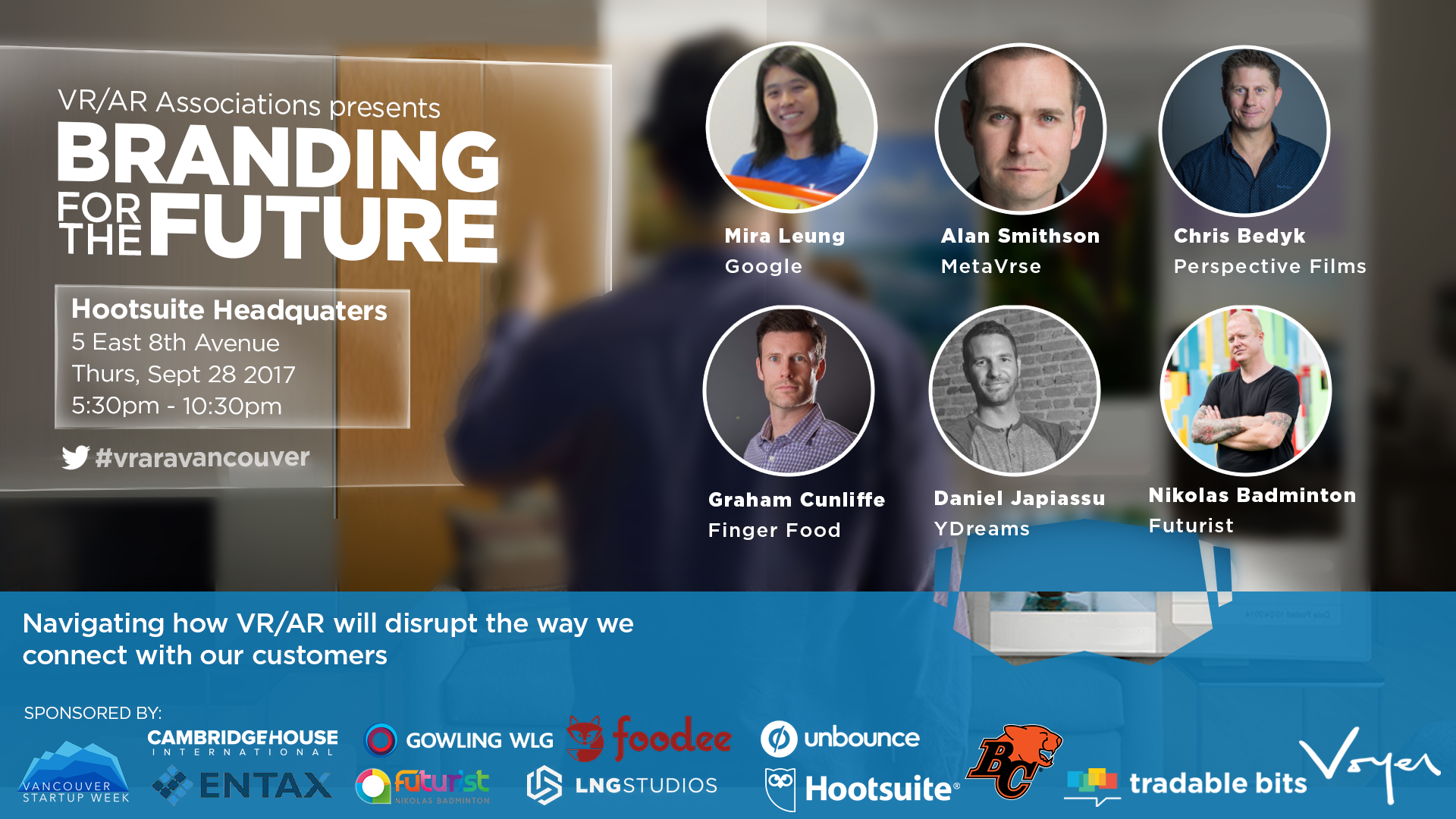
Highlights from VRARA Vancouver Branding for the Future (Sept Event)


VRARA Vancouver's biggest chapter event to date, Branding For The Future, took place September 26th at Hootsuite HQ. We had a full house sell out of attendees for an informative night discussing how immersive technology will disrupt the ways brands, companies, and retailers connect with consumers.
The night started with two keynote speeches to explore how Virtual Reality and Augmented Reality have already begun to change storytelling to consumers, and how immersive technology will continue to shape and enhance brand experiences.
First speaker was Alan Smithson, CEO of MetaVRse. On his talk "VR/AR for Business 101", he said traditional human communication mediums, such as TV, Radio, Internet, Mobile will not be going away anytime soon with the introduction of VR/AR. Simply put, augmented reality is going to be the next medium. He shared several examples of use case of AR in consumer engagement, including IKEA Place app. Alan spoke about how AR Kit was released 3 months ago, but IKEA managed to get their entire catalogue out because they started working on the product two years ago.
He urges businesses to "start now, because in a couple of years when [AR] is a commonplace and all of the big brands and your competitors have started this, you don't want to be left behind when this takes off as a communication medium."


The night was followed by second speaker, Mira Leung who is lead in ARCore at Google on "Engaging Audiences in VR/AR". She educated the audience on the technical foundation of immersive technology, and discussed engagement and visualization with AR. She says "the question will not be if but how and when VR/AR will be a significant portion of business process and customer experiences." She ended her speech on an encouraging note that what's next for VR/AR will rely on those in the audiences. Mira asked them to show the VR/AR industry what's possible, show what experiences and interactions they can create using their creativity and storytelling in combination with the technology.
Fireside chat was moderated by Nikolas Badminton, world-reknowned futurist speaker, author and researcher. The panelists were composed of industry thought leaders, including Chris Bedyk from Perspective Films, Daniel Japiassu from YDREAMS Global, and Graham Cunliffe from Finger Food, as well as the two speakers, Alan Smithson and Mira Leung. The fireside chat was a discussion about several topics. One of which was on quality of AR that is available today. Because the technology in its infancy, costs of delivering high quality VR/AR experiences is high. However the value and experience a consumer could get is often greater than having a high definition experience, especially if it is an experience that is unaccessible, such as BC Lions' dressing room.

After the speaker and fireside chat, attendees enjoyed themselves to refreshments and delicious selection of food, sponsored by Foodee, to enjoy while networking. There were also a handful of innovative companies showcasing their technology, such as Blueprint Reality, Questupon, Perspective Films, BioInteractive Technologies, cognitiveVR, radical.io, and LlamaZOO.
Here's the event recap video by NovusTV:
Here are the full speaker talks:
We would like to thank everyone that attended our event. Special thanks to our amazing speakers, as well as sponsors who made this happen: Hootsuite, Tradable Bits, Voyer Law Corporation, Vancouver Startup Week, LNG Studios, BC Lions, Unbounce, Futurist Nikolas Badminton, Cambridge International House, Entax, Foodee, and
Written by Laura Ryu, Marketing and Communications Manager VRARA Vancouver
Final Agenda Set for our VRARA & ARNY Event at SamsungNEXT in NYC
RSVP here

The VR/AR Association (VRARA) NYC Chapter and ARNY have partnered on this event hosted at Samsung NEXT on Tues, Oct 24.
VRARA's programs and initiatives are designed to accelerate anyone’s connections, knowledge, and growth. This includes the Industry Committees that work on specific verticals, which we will present during this event.
ARNY - Augmented Reality New York - is one of the first meetups in NYC; organizers include Ori Inbar and Pete Wassell.
Agenda:
- Kris Kolo, Global Executive Director, VR/AR Association
- Association members on different VR & AR Verticals Industry Committees
- Enterprise Howard Olah-Reiken
- AEC Polley Wong
- Criminal Justice Rory Wells
- Advertising Cortney Harding
- Storytelling Luis Navia, Michael Owen
- ARNY demos
- Dana Farbo - the latest and greatest from around the world of Augmented Reality
RSVP here


Há talento e génio em Portugal para inovar em realidade virtual e aumentada
Foi fundador de várias startups, que vendeu mais tarde a grandes empresas tecnológicas, como a Apple. Hoje, Kris Kolo é o rosto mundial da realidade aumentada e da realidade virtual, liderando a associação que representa o setor, a VRARA. Começou por trabalhar com tecnologias de localização como o GPS, antes de esta estar presente em todos os telemóveis e foi colaborador de empresas como a Toys R’ Us e a Verizon, tendo sido responsável pelo desenvolvimento de patentes que hoje são utilizadas pela Tesla. Agora, Kris Kolo acredita que o futuro passa por sobrepor informação digital no mundo real e por criar realidades puramente virtuais. E sobre os portugueses não duvida: “há talento e génio” no país para atacar estes mercados globais.
Os capacetes de realidade virtual que no passado eram ficção, hoje, já estão nas lojas. E o próximo passo está mesmo a chegar, acredita Kris: smartglasses, os óculos que juntam o real com o virtual. A realidade virtual e a aumentada, apesar de serem dois mercados distintos, complementam-se, acredita o especialista. E já são várias as grandes empresas tecnológicas — como a Google, Apple ou Facebook — a dar passos sérios no desenvolvimento deste mercado, que está avaliado em dezenas de milhares de milhões de euros.
“A realidade aumentada é muito poderosa para uma ligação emocional entre marcas e utilizadores”
Como se tornou presidente do associação global de realidade aumentada e virtual?
Estudei no Massachusetts Institute of Technology (MIT), considero-me um techie e um geek. Sempre tive uma paixão pelas tecnologias móveis e pela forma como podem melhorar o dia-a-dia das pessoas. Há dez anos ninguém tinha um smartphone. Hoje, todos temos e não vivemos sem eles. A realidade virtual (RV) e a realidade aumentada (RA) são as próximas grandes plataformas, o próximo paradigma. Tínhamos a Internet, tínhamos os smartphones e a RV e RA são o próximo “meio”, se é que lhe podemos apelidar assim. A Associação de RV e RA (com a sigla VRARA em inglês) começou em 2015, com o objetivo de acelerar o mercado das empresas que trabalham com estas tecnologias no mundo todo e ligá-las às pessoas. Queremos que todas as empresas trabalhem em conjunto para educar os consumidores — dos jovens às mães, pais e avós — a criar práticas e fazer crescer os utilizadores de realidade virtual e de realidade aumentada.
Este ano de 2017 é especial para realidade virtual e especialmente para a realidade aumentada. Temos grandes nomes como Tim Cook, da Apple, ou Mark Zuckerberg, do Facebook, a promover a realidade aumentada nas televisões, em eventos e a lançar produtos. Hoje, um iPhone atualizado com o sistema operativo iOS 11 já tem realidade aumentada lá dentro. Isto significa que tendo um iPhone, a câmara consegue fazer reconhecimento automático de imagens, sobrepor informação digital no mundo real. Basicamente, é olhar para o mundo real com o ecrã do smartphone e provavelmente, no futuro, com smartglasses [óculos em que as lentes sobrepõem informação digital ao mundo real] para se ver a informação digital com a realidade. Hoje, já é possível apontar o smartphone para um produto numa loja e ver o preço e críticas por cima, por exemplo.
No smartphone, qual é a melhor forma de utilizar estas tecnologias?
A minha utilização favorita é a do Google tradutor. É possível falar com o Google tradutor atualmente [não disponível em português de Portugal] e o sistema traduz o que o utilizador está a dizer para uma língua à escolha. Com a realidade aumentada podemos apontar o smartphone para um menu ou para as direções de uma paragem de autocarro e aparece a tradução no ecrã.
“Com a realidade aumentada pode-se apontar o smartphone para um menu ou para as direções de uma paragem de autocarro e aparece a traduzido no ecrã”
E isso já funciona?
Já funciona há algum tempo, a realidade aumentada não é uma coisa nova. Há aplicações com esta tecnologia nos smartphones nos últimos cinco/sete anos.
O Pokémon GO, por exemplo?
Exatamente. Foi a primeira aplicação a chegar a um grande número de consumidores e a ensinar o que é a realidade aumentada.
Mas o Pokémon GO não é tecnicamente realidade aumentada, pois não?
Tecnicamente, é a utilização mais básica que se pode fazer da realidade aumentada, porque usa a localização GPS do utilizador e baseando-se nessa informação mostra o conteúdo relevante. A diferença agora é que a realidade aumentada tem reconhecimento de imagem. Isto significa que a câmara do telefone ou, no futuro, dos smartglasses sabe reconhecer objetos, lugares e pessoas e a partir desse reconhecimento dá informação relevante ao utilizador.
É detentor de nove patentes. São todas de realidade aumentada e virtual?
Sim, tenho nove patentes, mas não são todas de realidade aumentada e virtual. Uma delas, por exemplo, diz respeito a um tablet para carros. Hoje, a Tesla e todos os novos modelos de carros usam essa tecnologia.
E estão todas a usar a sua patente?
Fiz as patentes quando trabalhava na Verizon, que nos EUA é o que a Vodafone é na Europa, mais ou menos. Tecnicamente, as patentes são da Verizon.
Mas também trabalhou com realidade aumentada enquanto estava na Toys R’ Us, certo?
Como referi, a tecnologia não é nova. Em 2013, estava a implementar uma tecnologia de realidade aumentada para compras — o consumidor chegava à loja e podia apontar a câmara do telefone a uma caixa de LEGO, por exemplo, e ter informação –, o objetivo era trazer os consumidores à loja e fazê-los interagir com os produtos. A realidade aumentada é muito poderosa para que as marcas se liguem emocionalmente aos utilizadores. Imagina a caixa de LEGO abrir-se sozinha à tua frente e a construção ganhar vida.
Nas lojas LEGO já há ecrãs que permitem fazer isso. Televisores grandes com câmaras que apontamos aos legos para vermos a construção.
Sim, isso é outra forma de interagir com realidade aumentada. E não é preciso que o consumidor pegue no smartphone.
Agora que os smartphones têm ferramentas próprias de realidade aumentada nos sistemas operativos, como o ARCore, para o Android, e o ARKit, para o iOS, qual é que acha que vai ser a grande utilização desta tecnologia?
Tanto a Google como a Apple estão a fazer boas coisas para a indústria. A limitação da Google, como os produtores e os utilizadores mais ávidos sabem, é haver fragmentação entre equipamentos [muitas pessoas têm telemóveis com sistema operativo Android, mas em muitos modelos diferentes]. Isto ao contrário da Apple que quando lançou o ARkit ficou disponível em 300 ou 500 milhões de aparelhos. Quando a Google anunciou o ARcore, este ficou disponível num ou noutro modelo Android apenas. No entanto, quando os utilizadores começarem a comprar novos telefones e a fazer update ao sistema, toda a gente vai ter realidade aumentada nos telemóveis, tal como hoje todos temos GPS.
“Há projeções de 80 a 90 mil milhões de euros”
Qual vai ser o próximo Pokémon GO?
Acho que o Pokémon é um jogo que surpreendeu porque mostrou que as pessoas querem ir “lá fora” e jogar com imagens de pequenos monstros à frente. O IKEA já tem uma app fantástica onde se pode “experimentar antes de comprar” móveis para as casas. Podemos, por exemplo, ver como fica um sofá na sala apontando o telefone e vendo no ecrã como fica. Automaticamente dimensiona o móvel às dimensões da sala.
É a próxima app mainstream (para as massas)?
Vão existir bastantes killer-apps para compras ou viagens. A app do IKEA é um bom exemplo. Mas há outra app que acho muito interessante que é a measuring tape [fita para medir, em português]. Quando uma pessoa está a decorar a casa ou a medir qualquer coisa tem de ter uma régua ou fita métrica, mas com esta app aponta a câmara e ela mede as dimensões.
Eles estão a trabalhar com a VRARA?
Muitas dessas empresas são parte da associação.
Para startups que trabalhem com realidade aumentada ou virtual, quais são as maiores dificuldades?
As maiores dificuldades começam por terem de adquirir conhecimento e pesquisa. Temos programas e iniciativas para ajudar estas empresas a acelerarem os negócios. Usamos casos de sucesso, modelos de negócio de empresas que já fazem dinheiro. Isto em todas as áreas, de videojogos à saúde e ao retalho. Temos diferente empresas que trabalham em protocolos específicos.
Hoje, quanto dinheiro está investido neste mercado?
Dois mil milhões, arredondamente. Grande parte disso está na Magic Leap que supostamente vai lançar smartglasses em 2018. A Snap, dona do Snapchat, também está a fazer muita coisa em realidade aumentada.
Trabalham convosco?
Ainda não, mas a Google está no nosso conselho consultivo. A Samsung também trabalha connosco.
A Bloomberg diz que em 2021 a realidade aumentada e a virtual vão representar um mercado de 401 mil milhões de dólares. É verdade?
Os números são realmente surpreendentes. A Goldman Sachs faz projeções de 80 a 90 mil milhões de euros. Dependendo do ano. 2020 ou 2025, as projeções envolvem sempre números muito grandes. O que é preciso perceber é que a realidade aumentada vai fazer parte das nossas vidas quotidianas. A realidade virtual é maior em entretenimento, filmes, jogos, mas também em saúde, cuidados de saúde e hospitais. Há clínicas a comprar capacetes de realidade virtual e a tratar pacientes para coisas como ansiedade ou lidar com a dor.
“Portugal está pronto para este mercado global”
O que o traz a Portugal?
Estou aqui porque está muita coisa a acontecer em realidade aumentada e virtual no país. Desde que cheguei, há apenas um dia, já me reuni com dez empresas.
Pode indicar algumas?
Uma é a IT People, que já trabalha com o Microsoft Hololens [óculos de realidade aumentada] há um ano e meio. São já um parceiro da Microsoft, já foram galardoados com o prémio Microsoft DX. Trabalham também o ARkit, ARcore, são verdadeiramente multiplataforma nos projetos que fazem.
Já os conhecia?
Só os conheci quando vim cá. Acho que é um desafio comum: pessoas fora de Portugal nesta indústria não conhecem o talento que há em Portugal. Por isso estou aqui e a começar este capítulo da VRARA em Portugal, para expor estas empresas fora de Portugal. E se tudo correr bem trazer mais clientes a estas startups.
Já têm presença noutros países?
É a nosso 40ª presença. Temos nas principais cidades na América do Norte, na Europa e na Ásia. E agora em Portugal.
Em comparação com os outrosmercados, como é Portugal?
O talento e o dinamismo são os mesmos. A IT People faz o mesmo que a app do IKEA faz. Se alguém tiver uma loja com produtos semelhantes, há talento em Portugal para criar isso.
É a sua primeira vez no país?
Não, já tinha vindo quatro vezes, sempre a Lisboa. Todas as vezes fico maravilhado com o país. Especialmente nesta viagem, sinto uma energia diferente. Ouvi dizer que toda a gente se está a mudar para Lisboa.
Sim, a cidade está a mudar muito, mas não é só Lisboa. Há um grande número de startups no Porto e noutras cidades. O que sente em relação ao know-how português em tecnologia?
Estou muito cativado. As empresas com que tenho falado em Portugal estão famintas por mais clientes e por chegar a mais gente, por isso é que nos queremos ligar a elas. Temos 3.800 empresas conectadas e o nosso objetivo é fazer com que todas cheguem aos consumidores.
Também é um empreendedor?
Sim, trabalhei na Toys’ R’ us, mas tive a minha startup que depois vendi a uma grande empresa. Também criei outra startup chamada Flyby, que foi comprada pela Apple. Sinto que posso contribuir muito como diretor executivo global desta associação. Tive startups, trabalhei com startups quando trabalhei para grandes empresas e isso é uma boa dinâmica.
Em Portugal, vê o espírito empreendedor?
Claramente. O que vejo que é precisam de mais exposição, mais investimento para se tornarem globais. Portugal está pronto para este mercado global. O talento e o génio está cá e, mesmo que não se saiba, toda a gente vai usar realidade aumentada e virtual. Antes era o mapeamento, depois a geolocalização. Já se passou o mesmo com outras tecnologias.
"vivia em São Francisco, que me faz lembrar muito Lisboa. Não só por causa da ponte, mas também pelas colinas, a comida e pelo espírito das startups"
Começou a trabalhar com essas tecnologias?
Antes de trabalhar na Verizon tive uma startup de serviços de localização, em Sillicon Valley. Por causa disso vivia em São Francisco, que me faz lembrar muito Lisboa. Não só por causa da ponte, mas também pelas colinas, a comida e pelo espírito das startups.
“A tecnologia está a ficar mais pequena, mais barata e mais leve”
Qual foi a primeira desilusão que teve com realidade aumentada?
Ainda são os primeiros dias, a tecnologia ainda está a evoluir muito. Mas atendendo que falámos do Pokémon Go, acho que foi enorme e que chegou a centenas de milhões de utilizadores. Foi um bom exemplo de realidade aumentada, mas o que me desiludiu é que foram passos de bebé. A utilização que o jogo faz de realidade aumentada é muito rústica, mas é a minha opinião. Para o público em geral, foi incrível. Como sou um techie, sei que a tecnologia consegue muito mais.
Qual é a empresa mais bem preparada para este mercado?
No lado do consumo, é definitivamente a Apple. Isto porque conhece o utilizador da melhor forma. Eles sabem como promover estas tecnologias e introduzi-las no mercado. Vão definitivamente liderar o mercado de realidade aumentada por uns tempos, a começar pelos iPhones. E vão começar a apresentar smartglasses nos próximos anos. A seguir, é definitivamente a Google e o Facebook. O Facebook está ter bastante sucesso neste mercado. O negócio deles é essencialmente a publicidade. Estão a fazer parceria com várias marcas e tudo.
O Facebook foi a primeira empresa a utilizar a realidade aumentada. No Instagram, temos as orelhas de coelho…
Isso mesmo. O Facebook, até a Apple ou a Snap. Para algumas pessoas pode ser engraçado ou geeky, mas eles fazem o reconhecimento facial com emoji, bitmoji, animojis…
Os animojis são realidade aumentada?
Os animojis usam o reconhecimento facial, é um tipo de realidade aumentada em que basicamente mapeiam a cara e criam um objeto 3D. Não é a definição de realidade aumentada, em que se sobrepõe digitalmente uma imagem num objeto do mundo real, mas está a usar a mesma tecnologia para reconhecer os objetos e criar um modelo 3D de uma cara como um coelho ou outro animal.
É um evangelista/promotor de realidade virtual e realidade aumentada, mas são mercados distintos ou complementam-se naturalmente um ao outro?
Os dois têm muito em comum, incluindo a tecnologia para criar experiências. Ferramentas como o Unity ou o Unreal Engine [software de criação de programas 3D utilizados para experiências RV e RA] são as mesmas e os objetos 3D que são criados para a realidade virtual podem ser utilizados na aumentada. Usam a mesma ferramentas “nos bastidores”, mas a diferença é o resultado final para o utilizador. Para a realidade virtual, o utilizador usa uns óculos especiais que criam um ambiente fechado, com a realidade aumentada é mais fácil, é possível “vê-la” com o smartphone, sem uso de acessórios.
Falava há pouco de smartglasses, mas ainda é preciso um computador externo para utilizá-los. Apenas os Google Glass, que não são tecnicamente realidade aumentada, usam o smartphone. Como acha que vai evoluir a tecnologia: andará connosco ou vamos ficar “presos” ao computador?
O que está a mudar é que a tecnologia está a ficar mais pequena, mais barata e mais leve. A realidade virtual começou com óculos, alguns ainda conectados por um cabo a um PC, mas isso está a mudar muito rapidamente. Todos – HTC Vive e Oculus – estão a lançar óculos de realidade virtual sem fios. Aconteceu o mesmo com os telemóveis no passado: eram muito grandes e ficaram muito pequenos. Acontece o mesmo com os óculos de realidade virtual e com os de realidade aumentada. O que também é interessante são os wearables [tecnologia que se veste] como o Apple Watch. A minha opinião é que a Apple vai introduzir uns smartglasses nos próximos anos, estão apenas à espera que o consumidor esteja pronto. A Apple não gosta de ser prematura nos lançamentos de tecnologia.
"a Apple conhece o consumidor muito bem e sabe como meticulosamente introduzir tecnologia no mercado e adaptar-nos a novos conceitos de tecnologia"
Isso significa que estamos a ser “educados” para usar estas tecnologia de realidade aumentada?
Sim, exatamente. Por isso referi que a Apple conhece muito bem o consumidor e sabe como introduzir meticulosamente tecnologia no mercado e adaptar-nos a novos conceitos de tecnologia. Uma das coisas que vi no evento de lançamento do iPhone X foi o Apple Watch, que introduziu chamadas e rede própria. Isso significa que não é preciso o iPhone para fazer chamadas. É uma mudança drástica no comportamento do utilizador poder deixar o telemóvel em casa e ir correr ou nadar com o relógio e poder telefonar. É uma alteração enorme sem o consumidor perceber que está a alterar comportamentos.
A tecnologia no futuro, especialmente a de realidade aumentada, vai estar presentes nos óculos comuns?
Sim. As pessoas já não vão utilizar o smartphone para tudo. Provavelmente vai ser controlado por voz e com auxílio de assistentes virtuais como a Siri.
Quanto à VRAR Association. É uma associação de influência para a implementação destas tecnologias ou para “evangelização”?
Todas as indústrias têm uma associação. Nós somos a associação para esta indústria: estamos a educar e a evangelizar o mercado, tanto os consumidores das empresas que se juntaram a nós como as empresas que querem entrar neste mercado.
Que empresas?
A Boeing está no nosso comité, a General Motors, entre muitas outras. Conseguimos construir nos últimos anos um bom ecossistema. Há outras associações locais para realidade virtual e a aumentada, mas nós somos a maior, de longe.
Source/Original article here

Video: A Window Into the Russian VR Market Presented at XRconnects
Sergey and Michael Doudy of the VR/AR Association Russia Chapter deliver an XR Business Session at XR Connects Helsinki 2017
VR/AR Association's Statement Regarding Robert Scoble
In light of recent news and allegations of sexual harassment by Robert Scoble, the VR/AR Association has formally removed Robert from our Board of Advisors. Our organization does not condone harassment of any kind, and feel that this is the best course of action.
We stand respectfully with all of those who shape our future, and are dedicated to fostering a safe space for all.
Apple Brought AR to Life
By Dan Sung, METRO

APPLE’S most significant launch of 2017 was not the iPhone X. Nor was it the Watch Series 3. In fact, it wasn’t a device at all but the iOS 11 software — specifically the framework inside it called ARKit, which will change the world as we know it.
ARKit is a set of tools for iPhone app developers, the people who turn pretty gadgets into genuinely useful items. ARKit makes it simpler for them to dream up augmented reality (AR) apps — those which superimpose computer-generated images on top of our view of the real world. It also makes AR work a whole lot better. Chances are you’ve already used augmented reality, whether you know it or not, through Pokémon Go or Snapchat and its animated selfie additions and filters, not to mention the dancing hotdog, which was viewed 1.5billion times over the summer.

Futuristic dream: Developers at Microsoft HoloLens are pointing the way, while Magic Leap has raised a staggering $1.4bn of backing for its projects
See Metro’s top ARKit apps (below) on the App Store for a taster of how Apple is set to make AR more fun and useful than ever before.
Augmented reality is nothing new but, much like its cousin virtual reality, it’s been waiting for someone to realise its potential. The success of Pokémon Go and its 650 million downloads was a marker of the appetite for AR, and this was nothing sophisticated. With ARKit, your phone can recognise the surfaces of your surroundings and put the virtual objects right on top of your desk or your car, instead of just leaving them floating aimlessly in the air. The iPhone’s dual cameras can sense depth far better, track your every movement and adjust the computer-generated overlays to match in a realistic way thanks to the high-performance A11 processor at the heart of the latest Apple handsets.
More important than the tech itself are the millions of iPhones and iPads already out there with potential AR users just waiting to get going. That’s a very different situation from the last big push for AR, which came courtesy of the Google Glass Project and its prohibitively expensive smart eyewear, its limited applications, its ‘glassholes’ label and the host of bad press around privacy.
‘The fixation that AR is dependent on consumer-grade AR glasses as the essential element for widespread usage is now over,’ says multimedia expert Ken Blakeslee of WebMobility Ventures.

‘Pokémon Go taught millions of consumers the value of the smartphone screen as a viable experience for AR. Apple has just put in place the platforms for rampant AR development and, with the capabilities of the iPhones 8 and X, everything is in place to finally exploit AR in a way consumers will find comfortable and valuable.’
Since Glass Explorer ended in 2015, Google has learned much about AR and now has a set of software tools for Android called ARCore. Expect an AR app explosion on Google-based smartphones.
But the futuristic dream of smart glasses isn’t dead, it’s just that our way of getting there has changed. According to Blakeslee, the focus on smartphone AR is going to accelerate the investment in AR eyewear that looks good and works perfectly. There are already rumours that Apple is in talks with optics firm Carl Zeiss to make Apple glasses.
Microsoft is trying out a more mixed-reality approach with its oversized, more VR-looking HoloLens headgear. The idea is to turn the space around you into a 3D version of your computer desktop. It takes your pictures, your graphs and your windows off your monitor and throws them out into the real world.
Graphic models of the solar system can float around your table, PowerPoint presentations can rise up from your desk and it’s a lot easier to achieve because none of the computer-generated wizardry is reacting to the world around it. Samsung, Acer, Lenovo and Dell all have HoloLens headgear in the pipeline.
While Apple and Google will create the appetite, Microsoft HoloLens can begin to build the future along with companies like the mysterious Magic Leap, according to co-president of the VR/AR Association, Steve Dann.
‘HoloLens is pointing the way’, he says. ‘Microsoft has been very brave to bring it out early and Magic Leap has had more money pumped into it than any new company in tech ever. A lot of people are betting that it not only works but that it’s going to be relevant for an awful lot of people. We’ve all got our fingers crossed.’
Vision: HoloLens turns space around you into a 3D version of your computer desktop
Magic Leap is the sweet spot in the middle, the name that’s been teasing the idea of super-smooth AR through its next-generation headset since 2016. Video demos of little cartoon characters hiding under objects have been enough to earn the company $1.4bn of backing. Word is that the device is bigger than a normal pair of glasses but smaller than VR goggles and that it projects a ‘light field’ of virtual images directly on to your retinas alongside everything else you normally perceive. Could it be the first company to crack smart glasses?

‘I’m pretty confident we’ll be wearing smart glasses within the next two or three years, looking slightly oversized but nothing that would be out of place on the street,’ says Dann. ‘After five or ten years they’ll be indistinguishable from normal glasses and people will have forgotten what life was like without augmented reality everywhere we go.’
With so many players in the game, it’s unlikely any company is going to own the space but Apple chief Tim Cook might just be able to look back and say that it was his firm that made AR finally click.
iPhone AR apps to try
IKEA Place (free)
Try before you buy and drop a true-to-scale piece of IKEA furniture into your living room before going to a showroom.
Hair Color by Modiface (£1.99)
Find out what you’d look like as a blonde or redhead. Front, side, back; it tints and tracks the lot.
Fitness AR (£2.99)
Show off your bike ride to your friends. Link it up to Strava to create a 3D tabletop map of your Herculean trail.
The Machines (£4.99)
Apple’s showcase AR gaming fun – a robot battlefield on your very own desk. Your orders, general?
ARCore + ARkit = Half a Billion Devices by Year-End (new report)
Subscribe to ARtillry Insights here.

There's been lots of talk about mobile AR's opportunity. And the best way to quantify that is through the installed base of AR-compatible devices in the market. So ARtillry set out to do just that in its latest report, accessible through VRARA's ARtillry Insights subscription.
The verdict: There will be 505 million AR-compatible smartphones by the end of 2017 and 4.2 billion by 2020. That may seem like steep growth, but is a function of hardware replacement cycles for iOS and Android (2.5 years) which will happen rapidly (methodology below).
One question is which AR platform is positioned better for growth and market share? It won’t be a winner take all market, just as iOS and Android have coexisted for years. And there is evidence that they’ll have some compatibility, or at least portability of graphical assets.
But they’ll still compete on many levels, and there are signals that indicate competitive differentiation on both sides. Google has greater scale and a technical lead from years invested in Tango. But Apple has more control over the hardware in its classic vertical integration.
In terms of reach, Apple has the short run advantage, based on a more unified hardware and software set that supports wider compatibility with ARkit, But Android will have the longer term scale as compatibility cycles into the much larger android universe.
ARkit and ARCore also carry their parents’ DNA. For Apple, it’s all about apps. For Google, the web. For developers making a platform choice, that means ARCore could reach more users, but ARkit couldbe more monetizable though app revenue models (dowloads, in-app purchases).
There's a lot more to it of course, and you can get a video summary below, and the full report here. Stay tuned for ongoing coverage as ARCore and ARkit continue to evolve and get deployed by mobile AR developers. it will be an exciting time.

Methodology: ARtillry's forecasting involves a unit-penetration model based on cumulative smartphone sales that go back 10 quarters (average replacement cycle), while also factoring in AR compatibility (for example, A9 chips or greater for ARkit, and Android 7.0 for ARCore).
Bay Area: Join Us at The Confluence Summit (10/27)
VRARA Members, contact us for a discount code

We're living in a period of technological convergence. And those converging factors notably include immersive technologies like VR and AR.
With that backdrop, Winston Baker will host the Confluence Summit, happening October 27, in Menlo Park, CA and featuring speakers like YouTube founder Steve Chen.
VR/AR Association, SF has partnered with the conference, meaning we have discount codes for members to save 30% on registration (contact us).
The conference program is here and you can register here. We hope to see you at the show.
More from the conference organizers
Since the earliest days of cinema and television, creative storytelling and technology have worked hand in hand to entertain audiences in new and exciting ways. One of the world’s greatest innovators of all time, Thomas Edison invented many devices that greatly influenced the world beyond the light bulb - for instance, the phonograph and the motion picture camera.
In more recent years, the era of VOD and digital distribution have profoundly affected the way in which the content business works. And now, with the proliferation of immersive experiences, both technology and entertainment sectors have a new set of opportunities and challenges to face.
What will the future hold for storytelling on new mediums? How will content be made, accessed and distributed? What devices will consumers adapt to?
As the forces of technology and entertainment continue to both disrupt and influence one another in this ever changing media landscape, how can tech developers and content creators combine efforts to take our generation’s innovative revolution even further? We hope to discover the answers at The Confluence Summit.
Learn more about VR/AR SF chapter here.
Recap of VRARA NYC Chapter Event ‘Narrative in VR: How to Create Compelling Stories with Virtual Reality’
By Chris Pfaff

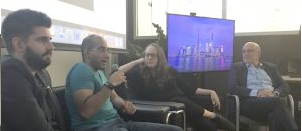
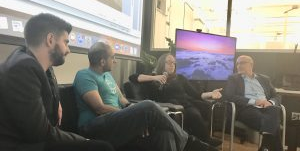
On a steamy late-September Monday (September 25, 2017), on the first day of Advertising Week New York, the VR/AR Association NYC Chapter hosted a panel with some of the leaders in VR storytelling, ‘Narrative in VR: How to Create Compelling Stories with Virtual Reality,’ at the NYU Tandon Future Lab.
Moderated by Chris Pfaff, the panel featured Brian Seth Hurst, Chief Storytelling and President at StoryTech Immersive; Raheel Khalid, CTO of Verizon envrmnt; Caitlin Burns, founder/CEO of Caitlin Burns & Associates, and Lewis Smithingham, president and partner at 30ninjas. An audience of 35 producers, artists, and students were part of a lively discussion regarding VR’s narrative structures, and how much of today’s VR industry has adapted game design techniques to better deliver moving experiences.
Brian Seth Hurst showed his groundbreaking piece ‘My Brother’s Keeper,’ which premiered on HTC Viveport at Sundance 2017, and was produced for PBS Digital Studios. Currently the most widely distributed VR film to date, ‘My Brother’s Keeper’ was what Hurst detailed as an invention process, as it is the first live action VR film shot at 120 frames per second, and includes innovation such as 180 framing and Bokeh inside the sphere.
Raheel Khalid showed some of Verizon envrmnt’s latest work, its ‘Virtual Sports Bar’ experience, which creates opportunities for multi-user drop-in experiences. He has helped build new tools for multi-user VR experiences that will enable producers and consumers to shape their own VR narratives in real-time.
Caitlin Burns described some of her work on Space Nation, a Helsinki-based organization that uses virtual experiences to train civilians for space travel. She also discussed some of her early learnings in VR storytelling, and how to overcome technological hurdles to maintain narrative focus.
Lewis Smithingham described challenges that he has faced with VR and AR productions, including his work for the ‘Conan O’Brien Show.’

Medical Education in 360 Video and Virtual Reality
By Brandon Birckhead MD, Co-Chair and Betsy Eble, Rafael Grossmann, Adriana Albritton, Participants of the VRARA Digital Health Committee

In the media, you may have heard “Running a Code” which is a protocol that is used when the patient's heart stops pumping. This procedure is taught in every medical school and is called Advanced Cardiac Life Support (ACLS). It is usually first taught in a simulation center with robotic patients and several team members. Each person has a different duty during the code including: performing CPR, obtaining vitals, managing airway, drawing up/giving medications, writing down the information of event, and one person to take lead in the situation. When the real thing happens these situations are intense and the room is packed with people.
How 360 degree video could be useful for Medical Education
Healthcare providers could replay their own simulated codes with a system that can help guide them to the correct course of action during the replay of the video. One could add arrows to point to areas that need attention first, i.e. the airway. The program could pause at critical moments to allow for input of options available to provider. A program could be built to test the student at the end of the replay using a “center of focus” heat map to find what steps they missed during the review. It may not be needed to have customized video for each healthcare staff member in training. A single recording may provide a significant benefit for provider training, however it would be interesting to see an experiment of the comparison.
One way to study this process is by placing the 360-degree camera where the head of the patient would be. Seeing things from the patient perspective can be quite humbling to see how your body language is perceived from their view point. Research has shown that a feeling of empathy can be invoked by a 360 video placed at the users point of view. Also it’s the one of the best positions for a three 360-degree video as the patient is usually in the middle of the room allow full use of 360 degree experience.
Another idea is to place of 2 or more of the inexpensive 360 video cameras would allow the student to change perspective during playback. This could be similar to the 360-video experience created by Intel (True VR) for MLB. Benefits would include the empathy gained from patient placement, a 3rd person view using an overhead camera to view all movement patterns and the placement of equipment staff during the Code and any additional placements that might benefit the student being trained. Adding in bio-feedback sensors to the simulations may help identify procedures, duties, situations of higher stress to the participants such as breaking bad news or assessing a dangerous situation. Integration of multiple scenarios or scenario branches integrated into a learning management system/single simulation would allow students to interact with the learning module. The students could be given a list of actions that each would start a new simulation.
Another interesting idea is the use of Eye Tracking technology. I've been working with VPS , a company that has a simple looking pair of glasses that track the focal point of view of the user. Integrating the "3d person view", the student would be able to see themselves in 360 camera. With this technology the analysis of where she was looking during the task, can have immense learning potential.
360 Video Success
One of the most successful startups in the VR industry, StriVR, uses 360 degree technology to train people to perform better at a task. They have had NFL teams, college teams, and major corporation as clients. Quarterbacks are able to go over plays many more times than just on the field. Now they are providing this technology to train Walmart employee.
Athletes become better by practicing. And being able to repeat movements and visualize situations without having to deal with a harsh environment or contact from an opposing team provides a competitive advantage. In the same manner, a person becomes more proficient and more able to master a skill by becoming more familiar with essential tools, viewing different perspectives, and playing diverse roles in a scenario. Practicing and role playing, also, diminish the shock and stress reaction that takes place when first responding to a crisis situation. Interactive experiences provided by 360 video and immersive VR can make learning much more comprehensive and deeply ingrained in your memory.
Interactive VR Experience
There is a company making an interactive VR experience for medical education, BioflightVR. The company has an emergency pediatric program that is similar to scenario stated above. It would be interesting to see the outcomes of both a 360 degree program and an interactive VR program. I imagine there there is more information gained by assessment and possibly more retention with the interactive VR program. However, a study could find them to be comparable. The advantage 360-video has over interactive VR is time needed to create the experience. If every hospital wanted to have specific simulations for each student it could not be done with the current methods of creating an interactive VR experience. However, 360 degree video equipment has advanced substantially and Medical Simulation Centers have several staff members that can handle video equipment.
There are several questions that could be examined in a research study to evaluate the use of this technology:
1) How does a 360-video feedback program compare to traditional video feedback for teaching medical students in regards to retention, preference, and assessment?
2) Does placement of 360 video affect the outcomes when using 360-degree video for feedback (ie from patient perspective vs center of room vs physician lead position)?
a. Secondary outcome: Is there an increase in empathy for patient with placement at patient perspective?
3) If medical students or residents take home 360-degree video for repeated playback over a set period of time does it have an impact on long term memory of protocol (Intervention during 2nd year medical school with assessment in 4th year)?
4) Are there improved outcomes (retention of knowledge, preference by student, and assessment by teacher) in using recorded simulations for each student vs a single simulated recording?
We are currently working with the other VRARA Digital Health Committee members to improve on this idea.
ARCore & ARkit: The Acceleration of Mobile AR (new report)
Subscribe to ARtillry Insights here.

Mobile AR hit an inflection point in 2017. It started with Facebook's Camera Effects Platform in April, followed by Google's "visual search" and "VPS." Then in June we saw Apple's ARkit, followed by Google's August ARCore launch.
Those last two are perhaps most impactful because of the tools they create for developers to build more advanced AR. Mobile AR can really scale when it's in the hands of developers, and when they're incentivized by an installed base in the hundreds of millions of devices.
We've recently quantified that installed base (ARCore & ARkit), but decided to take it a step further. ARtillry's latest Intelligence Briefing takes a deeper dive on ARCore and ARkit. How do they differ? What happens next? and what does it mean for AR developers?
The report tackles these questions, which you can preview and/or subscribe here. More can be seen below in the report's executive summary. Stay tuned for more analysis in the coming weeks, especially as mobile AR continues to evolve.
Executive Summary
Over the past six months, the tech sector has reined in its initial excitement about glasses-based augmented reality (AR). This includes realigned expectations on the time horizon to consumer ubiquity. But in the meantime, the AR world is keeping busy with another opportunity: mobile AR.
Beyond specs (battery life, field of view, etc.), AR glasses’ detriment is form factor: It needs to be sleek and cheap enough to sway consumers to reconcile a key point of friction: personal style. The bar is set high for anything people are asked to put on their face, as Google Glass taught us.
This concern goes away in enterprise contexts (the topic of another report) but is a sizeable barrier in consumer markets. And we’re a few years from marketable formats. The good news is that the stepping stone — or gateway drug as we like to call it — is mobile AR. And there’s a lot happening.
Going by the numbers, mobile AR’s addressable market isn’t the low-millions of headsets: it’s the 3.2 billion global smartphones today and 4.6 billion by 2020. Those aren’t all AR compatible in terms of optical and processing components, but most will be over the next replacement cycle (2.5 years).
Google’s AR development kit ARCore will become compatible with 3.9 billion global android devices during this time frame, and Apple’s ARkit will reach 673 million iPhones. Both achieve AR through software, utilizing the standard smartphone RGB camera, thus lowering the barrier to “true AR.”
Compared to graphics that simply overlay a scene, true AR infuses graphics that interact with physical objects in dimensionally accurate ways. ARCore and ARKit apply simultaneous localization and mapping (SLAM) through a surface detection approach that doesn’t require advanced optics.
The result is an overall democratization of advanced AR capability. This starts with the massive installed base mentioned above, which in turn incentivizes developers with a larger addressable market. Then the content they create entices more users to engage, enacting a virtuous cycle.
Looking forward, we can expect several AR apps as ARCore and ARKit gain footing. But more impactful will be years of third-party innovation with both SDKs. That could rival in creativity and advancement, the app economy itself, which kicked-off ten years ago with the first iOS SDK.
But several questions remain: How quickly will this happen? What are the pros and cons of each AR toolkit? What will be best practices in building, distributing and marketing AR apps? And what does it all mean from where you sit? These questions are tackled throughout this report.


USA Today Network’s VR Ad Studio has Shown There’s an Audience for VR Ads
USA TODAY NETWORK is a member of the VR/AR Association.
Join our Advertising Committee here.
The in-house studio has been working with brands to develop VR and 360 branded content and with Nielsen to measure the impact of these new ad experiences.

USA Today Network’s in-house studio, GET Creative, developed 360-degree/virtual reality branded content for Pure Michigan promoting travel and tourism to the state.
For the USA Today Network, virtual reality and 360-degree content is more than just hype. It’s becoming a revenue driver.
For roughly a year and a half, the Network has been working with advertisers to develop immersive branded content that can be distributed across its media properties.
The effort is spearheaded by the GET Creative unit, which launched in March 2016 as an in-house agency charged with executing projects for advertisers that can be promoted in all media that the USA Today Network operates in — including virtual reality (VR). The Network consists of over 90 local media properties and the flagship USA Today, reaching a combined audience of more than 100 million consumers in the US, according to the company.
GET Creative’s first project was for Honda. The team used VR to promote the carmaker’s ultrafast two-seat Indy race car. The branded VR experience put consumers in the passenger seat of the Indy car, rounding a race track at 200 miles per hour. That project “showed there’s an audience for VR,” said Kelly Andresen, SVP and head of GET Creative at USA Today Network, in a phone interview.
Most recently, the team launched a 360-degree campaign for Pure Michigan to promote travel and tourism to the state. Viewers can “look around” at the various points of interest profiled in the video.
Experimenting with turnkey VR-specific ad formats & measurement
In addition to branded content opportunities, the Network is experimenting with ad formats designed specifically for VR environments. The first is what the company calls a “cubemercial,” which puts the users inside a room or cube in which advertisers can project videos and other creative assets on all four of the “walls.” The aim is to make this entirely new format turnkey for advertisers by incorporating brands’ existing creative assets.
The Network has partnered with Nielsen to measure the impact of VR on brand metrics. “It’s an amazing medium for advertising,” said Andresen, “likely because it’s so immersive people remember the content and VR has a 2x brand recall compared to TV.”
The studio takes a multiformat approach: creating true VR content that requires a headset like Google Cardboard, Oculus or Samsung Gear VR and 360-degree content that can be distributed across mobile, desktop and app and does not require a headset.
“The multiformat approach expands reach, and we see 360 as a gateway to true VR,” says Andresen.
What’s holding VR advertising back?
Interestingly, scale isn’t what Andresen mentions when asked what needs to happen for VR ads to become mainstream. “We have seen growth in true VR reach and expect to see more with the lower price points and variety of headsets available,” she said.
Instead, she named two critical things that still need to happen for VR advertising to truly take off:
We need new words.
First and foremost, says Andresen, is the need to establish a common lexicon for VR. There is no way to describe a “shot list” and story line to a client, for example, and the point of view for the story line now depends on the user’s frame of reference. The entire industry — producers, story tellers, clients, agencies — needs to be able to communicate.
We need a standard that can scale.
Second is the need for standards for VR ads and one experience that can scale. “All of us are challenged to really think creatively here. I wouldn’t want us to default to things like pre-roll. That’s not a great experience and we know this. An intrusive ad experience in VR is particularly bad because users have nowhere to go. . . Product placement is an interesting approach, but there is a challenge for scale because it’s so specific to the context,” says Andresen. “Our first foray borrowed heavily from linear video, but we see more [opportunity]. Can we move to a standard that’s scalable? Branded content has been a solution in that has filled a void.”
Google introduced an early VR ad concept this summer, and startups like Immersv and Outlyer Technologies are early entrants working on VR advertising.
There is no lack of client interest, says Andresen. Initially, clients are seeking education on the size of the opportunity and capabilities. Budgets are different for every client, with some pulling from video budget, some have an innovation budget, and some — she points to Lexus’s work with Saatchi & Saatchi’s Team One agency — have already made the investment in VR and are just looking for scale.
For its part, Andresen says, GET Creative is in position togrow adoption of this new medium that could end up changing our perceptions of advertising.
What's the Role of Interactivity in VR Game Development?

In anticipation for the upcoming VRX Conference in San Francisco (Dec 7-8), VR Intelligence and the UK Dept of Trade & Investment have collaborated on a new report.
Entitled The Role of Interactivity in VR Game Development, the free report provides an in-depth look at the challenges and opportunities of interactivity and creating presence in VR game development and virtual worlds.
It features contributions from:
- Tam Armstrong, Studio Director, Polyarc
- Pablo Fraile, Director of Ecosystems, ARM
- Rob Whitehead, CTO, Improbable
- Jennifer Chavarria, Head of Studios, Kite & Lightning
- Simon Harris, Executive Producer, Supermassive Games
The report also explores
- Why interactivity is key to augmenting presence in VR – and how to do it best
- What can be done to drive increases in character and object interaction and how to take advantage of new technology advances, like eye and motion tracking?
- Perspectives on how important audio is in enhancing interactivity and presence in VR
The free report can be downloaded here, and VR/AR Association members can contact us for a 15 percent discount to the VRX Conference.
We hope to see you there.
