
Why XR Is Redefining Onboarding, Training, and Competitive Advantage
Extended Reality (XR) has quietly become one of the most powerful transformation tools available to modern organizations. While artificial intelligence dominates headlines, XR has been steadily maturing for more than a decade—moving from experimental pilots to measurable, enterprise-grade outcomes.
Today, XR is no longer about novelty. It is about performance.
From onboarding and training to design, operations, and customer engagement, immersive technologies are reshaping how people learn, collaborate, and execute. This executive overview explores what XR is, where it delivers the most value, and why forward-thinking leadership teams are treating it as a strategic imperative rather than an optional innovation.
What Is XR—and Why It Matters Now
XR is an umbrella term that includes Virtual Reality (VR), Augmented Reality (AR), and Mixed Reality (MR). Together, these technologies bridge the physical and digital worlds, enabling users to interact with data, environments, and processes in immersive, experiential ways rather than through flat screens.
The benefits of XR extend across nearly every major industry:
Faster and more effective learning
Improved safety and risk management
Reduced training and operational costs
Higher engagement and retention
Better decision-making through visualization
The global XR market was valued at approximately $64.5 billion USD in 2022 and is projected to grow at an estimated 43.5% annually through at least 2028. This growth reflects a clear reality: organizations are no longer asking whether XR works—they are asking where it delivers the greatest return.
The Onboarding Crisis XR Is Solving
Onboarding has long been recognized as a critical—but broken—phase of the employee lifecycle.
Research cited by Harvard Business Review shows that only about half of new hires are satisfied with their onboarding experience. The result is stark: approximately one-third of employees leave within their first 90 days.
This attrition represents a massive loss of time, talent, and capital.
XR directly addresses this problem by transforming onboarding from a passive, information-heavy process into an engaging, experiential journey. Immersive environments allow new hires to:
Practice real scenarios before facing them on the job
Learn through repetition without risk
Build confidence faster
Feel connected to the organization from day one
Enterprises that have adopted XR onboarding are already seeing measurable results.
Proven Impact: XR Metrics That Matter
Unlike traditional training tools, XR produces data-rich insights that can be tied directly to performance and ROI.
Common XR onboarding and training metrics include:
Completion rates and time-to-completion
Drop-off points and engagement levels
Error reduction and behavioral change
Knowledge retention and post-training performance
Support requests and learning curves
Conversion and productivity gains
When baseline measurements are established, organizations can generate auditable ROI reports.
Real-world outcomes are compelling:
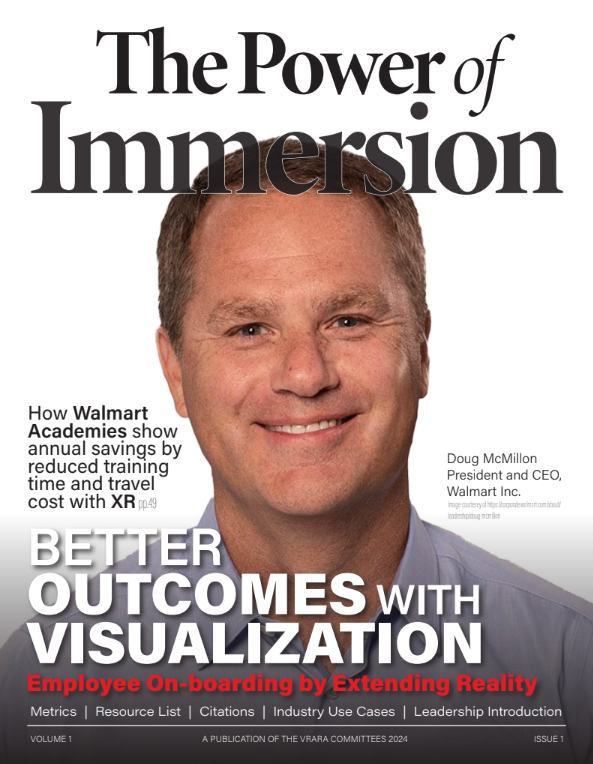
Walmart inferred over $38M in annual savings by reducing training time and travel costs
Healthcare XR training improved surgeon efficiency by 70%, unlocking $16.9M+ in annual benefits
Bank of America reported 100% of learners performing intended on-the-job behaviors after XR training
XR is not just more engaging—it is more accountable.
Where XR Delivers Value Today
XR adoption spans a wide range of industries and use cases, with momentum accelerating across both operational and customer-facing functions.
Automotive and Manufacturing
Global leaders including Ford, BMW, Volkswagen, Honda, and Porsche use XR for vehicle design, factory planning, digital twins, and remote expert support. These tools reduce development cycles, eliminate physical prototypes, and improve collaboration across distributed teams.
Energy and Industrial Operations
Companies like Duke Energy, Siemens Energy, BP, and Halliburton deploy XR for safety training, inspections, maintenance planning, and real-time asset visualization—often through digital twin environments that consolidate operational data into a single immersive view.
Training and Workforce Development
Organizations such as UPS, Nestlé, AXA, Woolworths, and Five Guys leverage XR to reduce time-to-competence, improve safety, and scale training across large workforces. Immersive simulations allow employees to learn by doing—without real-world consequences.
Healthcare
From surgical training to procedural confidence building, XR is improving outcomes and efficiency. Studies show dramatic gains in performance, confidence, and cost savings when immersive training replaces traditional methods.
Retail, Marketing, and Customer Experience
Brands including Walmart, LVMH, Tiffany & Co., Coca-Cola, and American Express use XR for virtual try-ons, immersive marketing campaigns, and interactive retail experiences—particularly effective with Gen Z and digital-native audiences.
What Makes XR Onboarding Successful
Not all XR programs succeed. The difference lies in strategy and execution.
Effective XR onboarding programs prioritize:
User-centric design that reduces friction
Accessibility and inclusivity across roles and abilities
Strong technical performance to avoid motion sickness or frustration
Security and privacy aligned with enterprise standards
Progressive learning paths that build confidence over time
Scenario-based training tied to real-world tasks
Feedback loops and assessments to drive improvement
XR onboarding works best when treated as a continuous learning ecosystem—not a one-time experience.
Leadership’s Role in XR Adoption
XR is not a plug-and-play solution. It is a leadership decision.
Organizations that succeed with XR share one common trait: executive commitment. Leaders who wait for competitors to prove ROI often find themselves permanently behind the curve.
As Michael Hotaling of ExxonMobil noted, “If you wait to invest until after your competitors have proven ROI, then you will always lag market value.”
XR rewards organizations willing to invest early, iterate quickly, and align immersive technologies with real business outcomes.
Why XR Is a Strategic Advantage
At its core, XR expands both digital and human capability. It enables faster skill development, stronger engagement, better risk management, and improved retention—all while creating measurable business value.
In a world defined by rapid change, XR helps organizations:
Attract and retain top talent
Adapt faster to new processes and technologies
Deliver better experiences to employees and customers
Stay relevant in increasingly competitive markets
Join the Community Leading XR Forward
The VR/AR Association (VRARA) brings together enterprise leaders, innovators, developers, researchers, and policymakers who are actively shaping the future of immersive technology.
Through global chapters, enterprise committees, research, events, and standards initiatives, VRARA helps organizations move from curiosity to capability—and from pilots to production.
If your organization is exploring or scaling XR for onboarding, training, operations, or customer experience, there has never been a more important time to engage.
Join the VR/AR Association and be part of the community defining how XR delivers real-world impact.
Because the future of work, learning, and experience isn’t theoretical.
It’s immersive.
