
AI + XR: Where Innovation Meets Enterprise Impact
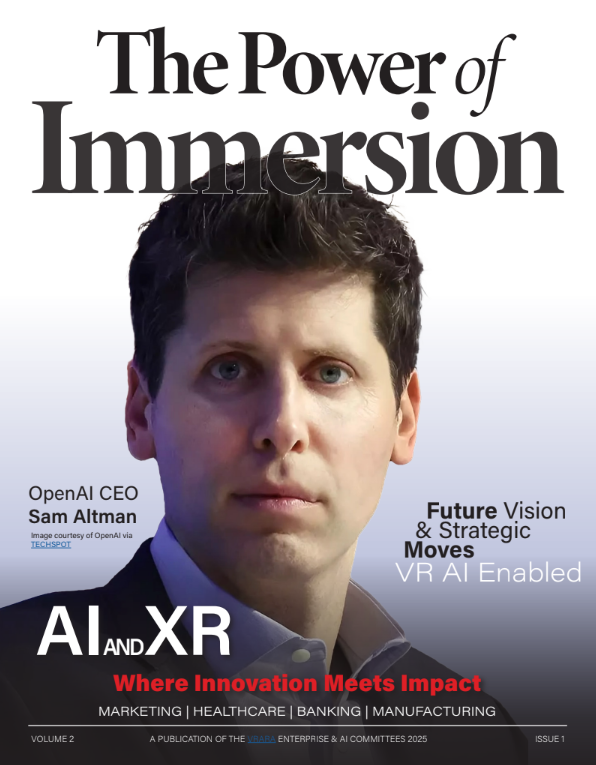
A decade ago, Extended Reality (XR) still carried a science-fiction stigma, and Artificial Intelligence (AI) was largely confined to recommendation engines and predictive text. Today, their convergence marks a decisive inflection point for enterprises.
This is not a design trend or a speculative bet. AI-powered XR represents a structural shift in how organizations train people, operate systems, make decisions, and engage customers. The question facing leaders is no longer if AI and XR will reshape business—but who will adapt fast enough to lead, and who will be left catching up.
From Experimentation to Enterprise Survival
AI provides the intelligence layer—language models, machine learning, analytics, automation. XR provides the interface—immersive, spatial environments where humans interact naturally with complex systems and data.
Together, they move enterprises beyond incremental efficiency gains toward scale:
Digital twins that allow teams to rehearse high-risk scenarios
Immersive training that outperforms classrooms and e-learning
Simulations that compress years of experience into hours
Adaptive environments that respond intelligently to user behavior
This convergence is already redefining productivity, engagement, and decision-making across industries—from healthcare and manufacturing to finance, retail, and urban development.
Market Momentum Is Accelerating
The market signals are unambiguous.
Global XR spending is projected to grow at a 27% CAGR through 2030
AI investment is expected to exceed $300B globally within the next year
Over 70% of Fortune 500 companies plan to pilot AI + XR initiatives by 2028
Rather than relying on acquisitions, the ecosystem is evolving through strategic partnerships—open platforms, interoperable hardware, and shared software stacks. Initiatives like Android XR and spatial computing platforms signal a shift toward scalable, enterprise-ready ecosystems.
This is no longer frontier experimentation. It is mainstream enterprise adoption.
Why AI + XR Works
AI + XR succeeds because it aligns with how humans actually learn and operate.
The brain builds understanding spatially. XR allows non-experts to interact with complex data intuitively, while AI adapts the experience in real time—personalizing content, pacing, and feedback.
Core advantages include:
Efficiency and Cost Reduction through automation, remote collaboration, and optimized workflows
Immersive Engagement that increases focus, retention, and emotional connection
Data-Driven Insight from behavioral analytics, performance metrics, and real-time feedback loops
Enterprises are not just visualizing information differently—they are making better decisions faster.
Industry Transformation in Practice
Healthcare: Precision, Training, and Patient Understanding
Healthcare has emerged as a proving ground for AI-powered XR.
Organizations are using immersive simulations for surgical training, AI-driven digital twins for procedure planning, and XR-based diagnostics that integrate real-time analytics.
The impact is measurable:
Faster learning curves for clinicians
Fewer procedural errors
Improved patient understanding and consent
Earlier and more accurate diagnoses
By combining spatial visualization with AI analytics, healthcare teams can practice, plan, and perform with greater confidence and consistency.
Education & Workforce Training: Learning at Scale
Traditional e-learning struggles to deliver adaptive feedback, experiential practice, or consistent quality at scale. AI + XR closes that gap.
Immersive conversational agents now coach learners in real time. Personalized scenarios adapt to skill level, confidence, and performance. Training becomes faster, safer, and more engaging.
Results across academic and enterprise programs show:
Faster skill acquisition
Higher confidence and reduced anxiety
Increased engagement and knowledge retention
For enterprises, immersive training is no longer just a productivity tool—it is a strategic capability.
Banking & Financial Services: Confidence, Compliance, and Trust
Financial institutions are deploying AI + XR for onboarding, compliance training, and customer education.
Immersive role-play scenarios improve employee confidence at scale, while AI-driven assistants guide customers through complex financial decisions.
The outcomes include:
Faster onboarding of large workforces
More consistent compliance outcomes
Reduced wait times and improved customer satisfaction
Retail & E-Commerce: Personalization That Converts
Retailers are using AI-powered XR to bridge the gap between physical and digital commerce.
Virtual try-ons, immersive brand experiences, and AI-driven recommendations reduce returns, increase conversion rates, and raise average basket size.
The result is not novelty—it is measurable revenue impact.
Manufacturing & Logistics: Safety, Speed, and Knowledge Retention
Manufacturing environments benefit immediately from AI + XR adoption.
Use cases include:
AR-guided assembly and quality control
VR training for hazardous or infrequent tasks
AI-optimized logistics and warehouse routing
Organizations report fewer errors, faster training, improved safety, and better retention of institutional knowledge as experienced workers retire.
Urban Planning, Construction, Defense, and Security
Across smart cities, construction sites, and defense organizations, AI + XR enables teams to simulate complex environments, align stakeholders, and reduce risk.
From infrastructure planning to mission-critical training, immersive intelligence allows organizations to rehearse reality—before consequences are real.
Responsibility Is Not Optional
As AI and XR converge, ethical, privacy, and security considerations move from the margins to the center.
Biometric data, motion tracking, eye movement, and behavioral analytics introduce new responsibilities. Compliance with regulations, bias mitigation, and transparent governance are prerequisites for sustainable adoption—not afterthoughts.
The organizations that win will invest in trust as deliberately as they invest in technology.
Building Competitive Advantage with AI + XR
The real differentiator is not hardware or software—it is culture.
Enterprises leading in AI-powered XR share common traits:
Willingness to experiment and iterate quickly
Cross-functional alignment between technology, operations, and leadership
Focus on scalable use cases tied to business outcomes
Commitment to responsible innovation
They are not just adopting tools. They are redefining how teams learn, how data informs decisions, and how immersive experiences drive engagement.
The Future Is Already Here
AI + XR is no longer about what might be possible. It is about what is already working.
Organizations that move now will define the next generation of enterprise operations. Those that hesitate will find themselves adapting to standards set by faster, more agile competitors.
The question is simple:
