
Designing Authenticity in AR Storytelling: Why "Wow" Isn't Enough
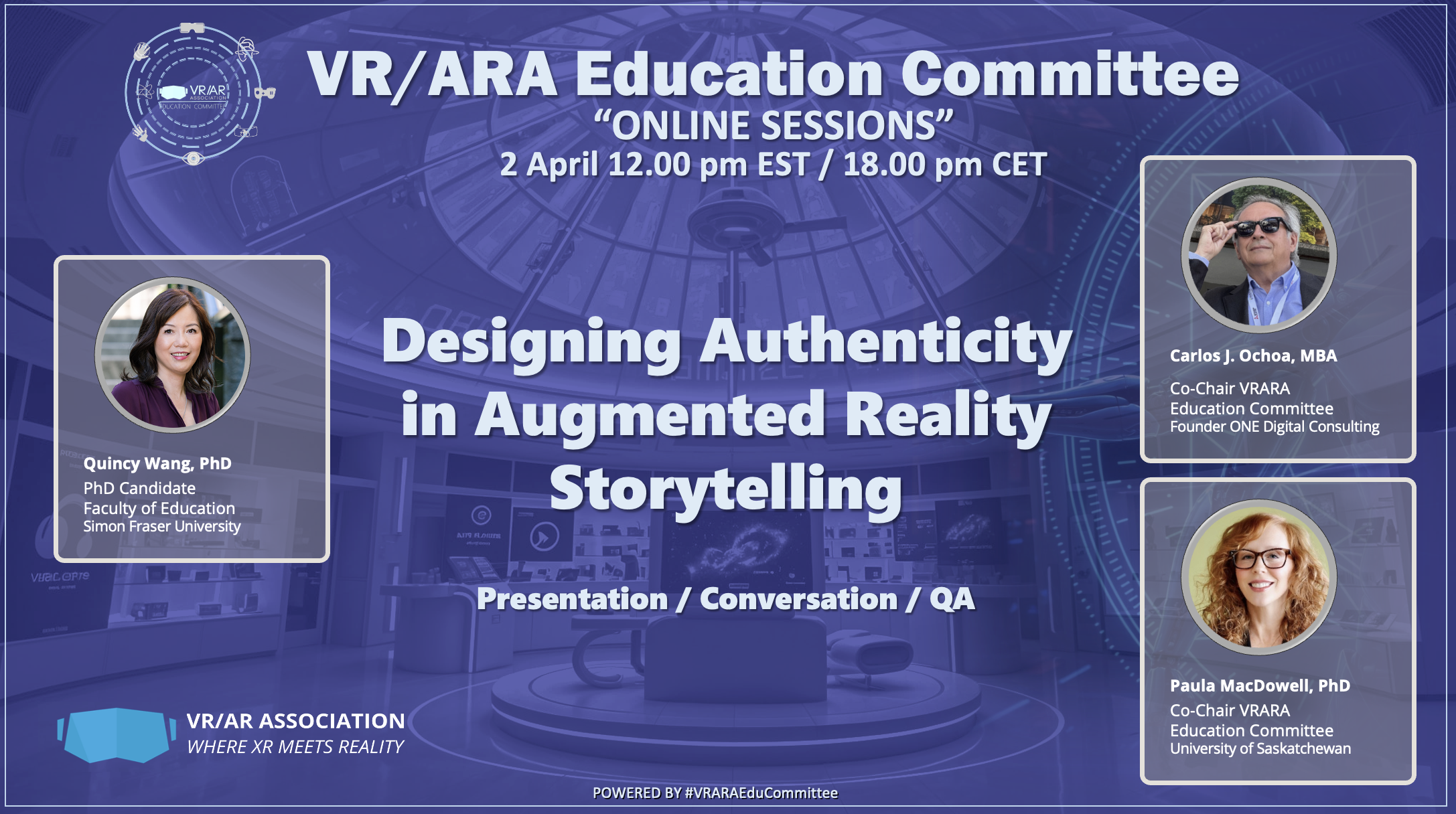
VRARA Education Committee | April 2, 2026 | 12:00 PM EST
The XR industry has spent years proving that augmented reality can capture attention. Now comes the harder question: can it actually teach?
This Thursday, the VRARA Education Committee hosts a session that goes straight at that challenge — and offers a practical framework for every educator, instructional designer, and XR solution provider working at the intersection of immersive technology and learning.
About the Session
Quincy Wang, researcher at Simon Fraser University, presents Designing Authenticity in Augmented Reality Storytelling — a session rooted in the theory and practice of authentic learning design applied to AR environments.
The session covers:
From AR Storytelling to Authentic Learning — how narrative-driven AR experiences can move beyond surface engagement to support meaningful skill development
Deepen learner engagement through interactive, contextually grounded experiences
Support authentic learning by connecting AR tasks to real-world contexts learners actually care about
Encourage creativity, participation, and learner agency — not just passive consumption
Move beyond novelty toward intentional pedagogical design that stands up to scrutiny
The Design Questions That Matter
Quincy frames the session around three questions every AR educator and solution builder should be asking:
How can AR storytelling be designed to support authentic learning — not just engagement?
What makes an AR experience educationally meaningful, not just visually impressive?
How can narrative, interaction, and context work together to strengthen learning outcomes?
These aren't abstract questions. They're the difference between an XR product that gets adopted in schools and training programs — and one that gets shelved after the demo.
Why This Matters for XR Solution Providers
If you're building immersive learning tools, this session is a direct line to understanding what educators actually need from your product. The gap between "cool demo" and "repeat purchase" often comes down to whether the learning design holds up. Quincy's framework offers a lens for building AR experiences that educators can justify adopting — and learners can grow from.
The VRARA Education Committee has become one of the most active communities in the association precisely because this gap is real, and the people in this room are actively closing it.
About the VRARA Education Committee
Co-chaired by Paula MacDowell (University of Saskatchewan) and Carlos Ochoa (VRARA), the Education Committee brings together over 770 educators, researchers, technologists, and XR innovators worldwide. The committee meets regularly to share research, real-world practices, and live sessions showcasing the power of XR, AI, and the Metaverse for learning and training.
Join the Conversation
📅 Thursday, April 2, 2026 🕛 12:00 PM EST / 6:00 PM CET 🔗 [INSERT MEETING LINK]
This session is free and open — but if you want ongoing access to the full committee program, early access to Immerse Global Summit speaker content, and discounts on IGS event tickets, VRARA Membership is the move.
👉 Join the VRARA → thevrara.com 👉 Explore Immerse Global Summit → immerseglobalnetwork.com