
Samsung Confirms Android XR Smart Glasses Are Coming in 2026, And VRARA Member Qualcomm Is Building the Silicon Behind the Revolution
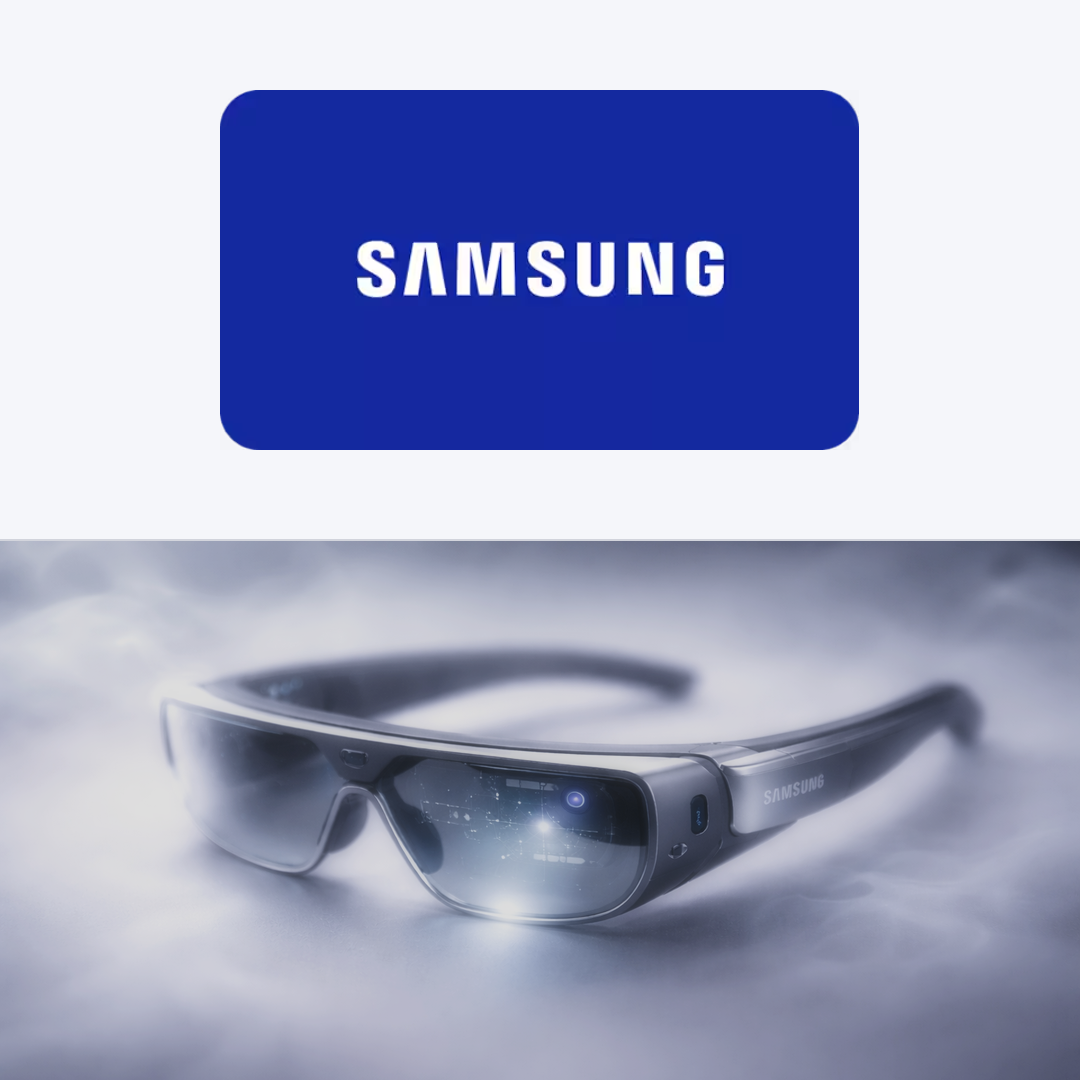
Artist rendering of potential look of Samsung’s AI glasses
By the VR/AR Association | February 2026
The spatial computing race just entered a new gear.
During Samsung's Q4 2025 earnings call in late January, EVP of Mobile Experiences Seong Cho made it official: Samsung will launch its next-generation AR smart glasses later this year. The glasses will deliver what Cho described as "rich, immersive multimodal AI experiences", and they'll be built on Android XR, the open spatial computing platform co-developed with Google.
But here's what caught our attention at the VR/AR Association: early reports point to Qualcomm's Snapdragon AR1 platform at the heart of these glasses, with purpose-built silicon for lightweight smart glasses from one of our longtime member companies, Qualcomm Technologies, Inc.
And that's a distinction worth understanding. Qualcomm's AR1 family is specifically engineered for all-day wearable AR glasses, which are entirely separate from the Snapdragon XR2+ Gen 2 chipset that powers heavier headsets like Samsung's own Galaxy XR. Different form factors, different silicon, different opportunities for solution providers.
This isn't a minor detail. It's the foundation.
Why This Matters for XR Solution Providers and Buyers
For years, the XR industry has been waiting for the hardware layer to catch up with the vision. That wait is ending fast.
Samsung is reportedly developing two distinct models of XR glasses (internally tracked as SM-O200P and SM-O200J), both expected to ship in 2026. Early reports point to a 12MP camera with autofocus, gesture-based controls, a compact 155mAh battery optimized for all-day wear, and deep integration with Google's Gemini AI assistant. The glasses may weigh as little as 50 grams — light enough to wear comfortably throughout a full workday. Leaked specs suggest the glasses will be powered by Qualcomm's AR1 platform — though Samsung has not confirmed whether they'll use the current AR1 Gen 1 (which already powers the Ray-Ban Meta glasses) or the newer AR1+ Gen 1 that Qualcomm unveiled at AWE 2025.
And it's important to understand where this sits in Qualcomm's broader spatial computing portfolio. The AR1 family is purpose-built for lightweight, all-day smart glasses. It's a completely different product line from the Snapdragon XR2 series (which has gone through multiple generations: XR2 Gen 1, XR2+ Gen 1, XR2 Gen 2, and the XR2+ Gen 2 that powers Samsung's Galaxy XR headset). There's also the AR2 Gen 1, designed for more advanced AR glasses with full six-degrees-of-freedom tracking. In short, Qualcomm isn't building one chip — they're building an entire silicon ecosystem that spans every XR form factor from heavy headsets to everyday eyewear.
Meanwhile, Qualcomm isn't standing still on the glasses front. At AWE 2025, the company unveiled its Snapdragon AR1+ Gen 1 chipset — a 28% smaller, more power-efficient processor capable of running Meta's Llama 3.2 AI model entirely on-device. No phone required. No cloud dependency. Qualcomm's VP of XR, Ziad Asghar, demonstrated what he called "a world's first: an autoregressive generative AI model running completely on a pair of smart glasses."
That's the kind of breakthrough that turns concept demos into commercial products — and opens massive doors for enterprise XR deployments.
The Bigger Picture: An Open Ecosystem Is Forming
What makes this moment different from previous cycles of XR hype is the ecosystem play happening behind the scenes. Android XR isn't a single product — it's a platform designed to support headsets, tethered glasses, standalone AR glasses, and AI-only frames across multiple manufacturers.
Samsung's Galaxy XR headset is already on the market in the U.S. and South Korea (with global expansion planned for 2026). Snap just spun out its AR glasses effort into a standalone subsidiary, Specs Inc., and is hiring nearly 100 people globally ahead of a consumer launch. Google has previewed partnerships with Warby Parker and Gentle Monster for consumer-friendly Android XR eyewear. And Qualcomm's chipset portfolio — spanning lightweight glasses to full immersion headsets — is the common thread tying it all together.
For XR solution providers, this means the addressable market is about to expand dramatically. For enterprise buyers evaluating spatial computing investments, the "wait and see" window is closing.
What This Means for the VRARA Community
Companies like Qualcomm don't just build chips — they build the infrastructure that the entire XR ecosystem depends on. Their membership in the VR/AR Association reflects a commitment to advancing the industry collaboratively, not just competitively.
At the VRARA, we exist to help solution providers get in front of the right buyers, and to help enterprise decision-makers navigate this fast-moving landscape with trusted research, connections, and insights. When a platform shift of this magnitude unfolds, the companies that move early — with the right network behind them — are the ones that win.
Stay Ahead of What's Next
The Immerse Global Summit Series 2026 is being relaunched with focused editions across Enterprise, Healthcare, Education, and Media & Entertainment — designed specifically for solution providers, systems integrators, and enterprise buyers to meet, demo, and close deals.
VRARA members get exclusive discounts on Immerse Global Summit tickets, early access to speakership and sponsorship opportunities, and promotion of their solutions across our 50,000+ professional network.
Whether you're building on Qualcomm's latest silicon, developing spatial apps for Android XR, or evaluating XR solutions for your enterprise — this is your community.
Ready to grow, learn, and connect with the most active XR network in the world?
👉 Join the VR/AR Association: www.thevrara.com
👉 Immerse Global Summit 2026: www.immerseglobalnetwork.com
Sources: Android Authority, Samsung Newsroom, Tom's Guide, Engadget, TechCrunch, Business Standard, UploadVR, Digital Trends